Thursday, May 6, 2010

Know your Florida Natives

A large portion of Gatorland is built around displays of animals from Florida and elsewhere. So today you get a quiz: are these Florida natives or critters from outside the Sunshine State?

Greater Flamingo. Florida Native?

Possibly. From eNature.com: "Resident in Bahamas, West Indies, Yucatan, northern South America, and Galapagos Islands. A casual visitor to U.S. coast from Carolinas to Texas. This species was formerly more numerous and probably bred at one time along the coast of Florida. Jeff Klinenberg reports in a 2002 St. Pete Times article: "Are they or are they not Florida residents? A prominent ornithologist described seeing an immense flock -- more than 2,000 birds -- near Cape Sable, in the western Everglades, in 1884. In 1901, an expert birder reported seeing a number of flamingos at Sugarloaf Key, near Key West, sitting on what appeared to be nests. Many experts today scoff. It's the only account of a flamingo nursery in the Florida wild. But nobody wants to say it's impossible."

Green Heron. Florida Native?

Yes. From the Cornell Lab of Ornithology website: "A small, stocky wading bird, the Green Heron is common in wet spots across much of North America."

Parrot. Florida Native?

No. This is the Yellow-naped Amazon Parrot. From Avianweb.com "Yellow-napes are endangered in their natural habitat which can be found along the Pacific Slope of Central America, in Southern Mexico and North-western Costa Rica."

Eastern Cottontail. Florida Native?

Yes. From wikipedia: "The Eastern Cottontail can be found in meadows and shrubby areas in the eastern and south-central United States, southern Canada, eastern Mexico, Central America and northernmost South America."

Blue Tilapia. Florida Native?
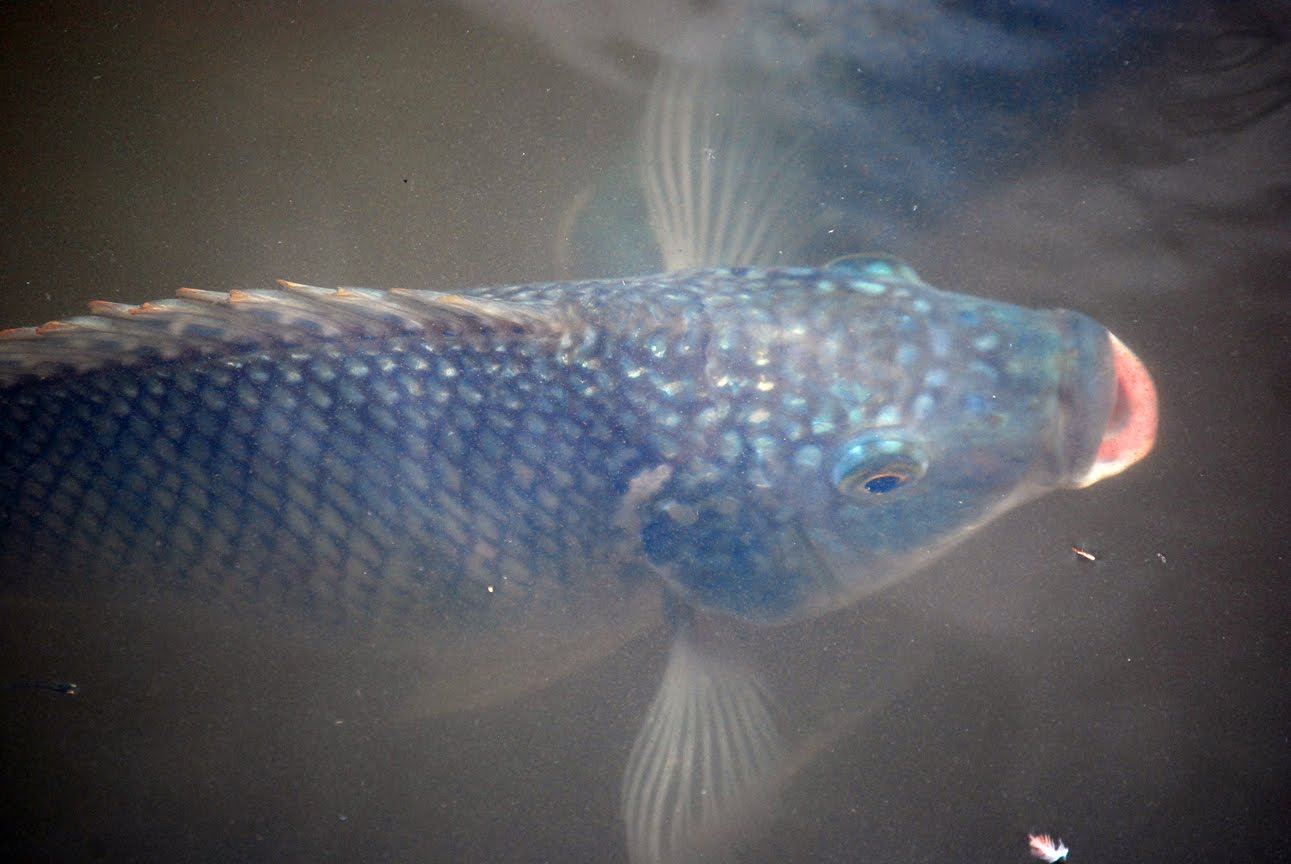
No. From the Environmential Defense Fund website: Most tilapia is imported from Latin America and Southeast Asia, where management and farming practices are less environmentally friendly than in the U.S. Since tilapia are not native to these areas, severe ecological damage can occur if tilapia escape to the wild.

Wood Stork. Florida Native?

Yes. From the Audubon website: "The striking, long-legged Wood Stork lives in colonies in cypress and mangrove swamps in the southeastern United States. It frequently flies in flocks, alternately flapping and gliding, or soaring on thermals to great altitudes. North America's only native stork, it is sometimes called "ironhead" or "flinthead" for its featherless, dark-skinned head."

Common Moorhen. Florida Native?

Yes. From the Cornell Lab of Orinthology: "The most widely distributed member of the rail family, the Common Moorhen inhabits marshes and ponds from Canada to Chile, from northern Europe to southern Africa, and across Asia to the Pacific. Vocal and boldly marked, the species can be quite conspicuous, sometimes using its long toes to walk atop floating vegetation."

Peacock. Florida Native?

No. From crystalinks.com: "Peacock or peafowl, large bird of the genus Pavo, in the pheasant family, native to E Asia. There are two main species, the common (Pavo cristatus), and the Javanese (P. musticus) peacocks, both found in deep forest where they travel in small flocks. A third type, the Congo peacock, was discovered recently in Africa."

Macaw. Florida Native?

No. From Avian Web: "Their native habitats are the forests, especially rain forests, of Mexico and Central and South America."

Gopher Tortoise. Florida Native?

Yes. From gophertortoise.org: "The gopher tortoises can be found throughout the state of Florida and southern areas of Georgia, South Carolina, Mississippi, Alabama and the tip of Eastern Louisiana."

Sandhill Crane. Florida Native?

Yes. From the International Crane Foundation website: "Sandhill Cranes are the most abundant of the world's cranes. They are widely (though intermittently) distributed throughout North America, extending into Cuba and far northeastern Siberia. The three migratory subspecies (Lesser, Greater and Canadian) are distributed across a broad breeding range in the northern U.S. and Canada as well as eastern Siberia, with wintering grounds in the southern United States and northern Mexico. The three non-migratory subspecies (Mississippi, Cuban, and Florida) have restricted ranges in the southern United States and Cuba."

Black Vulture. Florida Native?

Yes. From the Pergrine Fund website: "These vultures are found in lowland areas along rivers or in open habitats in the southern United States and throughout Central and South America."

Scoring:
12-10 correct answers: You're a genuine Florida Cracker
9-7
correct answers: You love your sunshine state critters
7-5
correct answers: You like pretty birdies but don't remember their names
4-2
correct answers: You rarely go outside because "they" might get you
2-0
correct answers: You've suffered major trauma to the head, and it's not your fault

Tuesday, May 4, 2010

Alligator Capital of the World

Florida has a long, interesting relationship with the alligator. These prehistoric looking creatures, seem docile and slow but actually possess incredible strength and quickness. It is easy to find numerous historical images of people wrestling, feeding and riding these massive reptiles, however, well into the early twentieth century. In fact, Orlando's signature historical image, reproduced in bronze in front of the History Center, shows gator wrestler Bunk Baxter sitting atop a crocodile in downtown Orlando.

Orange County Regional History Center

State Archives of Florida

The first to wrestle alligators were the Seminole Indians and early attractions sprung up in South Florida where gators and indians provided entertainment to northern tourists at places like Musa Isle and Tropical Hobbyland. A narrative by a contemporary alligator wrestler explains: "When we are alligator wrestling we are demonstrating what is really just a traditional barehanded technique for catching alligators as the Native Americans here in the glades have done for centuries. The Native Americans of Florida would catch alligators to feed their people. We catch them for the same reason, to make money to feed our families. Alligator wrestling is very dangerous and if a wrestler makes a mistake it could be disastrous, resulting in the loss of valuable body parts. I have seen a lot of people I know bitten by alligators."


State Archives of Florida

And so it was on a previous visit to Gatorland when I just missed one of the gator wrestlers being bit on the head during the show. My out-of-town visitors, who I left at the park to go back to work, got to witness the spectacle and fortunately the wounds to the Gatorland employee were not serious.

Gatorland opened in 1949 as the Florida Wildlife Institute according to an article in Reflections from Central Florida. Owen Godwin's family opened the park on US 441 to capitalize on the post WWII tourist boom as vacationing Americans took to the road in record numbers. The Godwin family still runs the park, a "110-acre theme park and wildlife preserve, combining "Old Florida" charm with exciting, new exhibits and entertainment." The park carries on the Florida traditions of hand-feeding alligators and gator "wrestlin'" but the only gators you can sit on today are made of fiberglass.


State Archives of Florida

The Breeding Marsh, where the rookery is located, is towards the back of the attraction. Towards the front lies "Gator Lake" and "Alligator Island" as well as assorted man-made ponds where one can witness gators of all shapes and sizes, in some places they stack themselves 4 deep. Guests can feed the critters in these ponds, which include brave turtles, so wading birds hang out in hope of a free lunch. This affords another opportunity for great photography.


Gator Jaws and Mold-A-Rama


I had not been back to Gatorland since they had suffered a fire in their gift shop that threatened the famous gator jaws entrance. An icon of Florida tourism, the enormous mouth used to lead you directly into the gift shop; now they've moved the door off to the side and the wall behind it has a nice Florida mural on it. I believe the entire building was replaced and I was happy to see the jaws were largely unchanged.


Former location of the jaws, photographed in the pre-digital era.

Even earlier location of jaws from the State Archives of Florida

A remnant of the terrazzo floor from the 1950s gift shop

The gift shop itself has the usual tourist trinkets you see in most souvenir stores around Florida: t-shirts, postcards, orange wine, alligator heads, etc. I was after bigger game myself, the coveted Mold-A-Rama plastic souvenirs from inside the park.


They have 2 machines inside, one creates an image of a white alligator currently on display from the New Orleans Zoo. The other is an olive green likeness of a gator wrestler. I remember Mold-A-Rama machines from when I was a kid, (I was never allowed to get one of the coveted, warm toys), and the smell of the melted plastic brings back strong memories of going to attractions from KSC to Marineland with my family in the '60s and '70s.


My souvenir is being made inside the mold

According to an article in the St. Pete Times, Mold-A-Rama machines were invented in the '50s but a new machine hasn't been manufactured in over 40 years. And not surprisingly the Sunshine State is the Mold-A-Rama capital with more machines than any other state. Other Florida sites where one can purchase a Mold-A-Rama treasures include the Lowery Park Zoo and Busch Gardens.

I realized that I now have 3 little statuettes made from Polyethylene pellets, (the 3rd is on display at the History Center as part of their tourism exhibit), and I am now officially a Mold-A-Rama collector. Watch out Ebay!


Monday, May 3, 2010

The bird rookery at Gatorland

I have been to Gatorland, the dinosaur of Central Florida attractions, several times as it is a mere thirty minutes from my house. My wife had free tickets so we spent a warm overcast Sunday afternoon playing tourist and it was amazing trip. Despite what my brother would call "flat" light, I was incredibly inspired by the details, colors and textures of this family-owned park and I had a ball taking pictures. I skipped the Gator Jumparoo and Gator Wrestling so I could spend the majority of my time in the rookery observing hundreds, perhaps thousands of wading birds nesting. For a bird lover like myself, I can honestly say it was the thrill of a lifetime. A boardwalk along the lagoon allows for easy access to see amazing avian behavior just feet away from your camera lens. The sounds of the birds are deafening as chicks squawk to be fed, protective parents loudly chase away intruders and others sporting their full breeding plumage just seem to want to be noticed.

A Tricolor Heron arranges her beautiful blue eggs.


These baby egrets were loud and fuzzy, so ugly that they're cute.

Just below, a vigilant eye watches for any chicks that might fall from the nest.

Some thing riled up this great egret, who is letting his displeasure be known quite loudly!

Even the cattle egret, looked spiffy sporting their breeding plumage.

This wet pile of feathers appeared to have very recently just left the safety of their shells.


Apparently it's alligator breeding season too!

After looking at the amazing images on the Gatorland website, I realize that there was a great deal I didn't see on this visit, and I will return, perhaps next season to observe this fantastic show again. To me this trumps any trip to Disney or Universal!