Thursday, April 15, 2010

La Leche Shrine, Florida's oldest attraction?


Growing up in Gainesville, I visited the nation's oldest city of St. Augustine at least once a year as a kid. We usually stuck to visits to the beach, fort and St. George Street, and never visited the attractions outside the core of the old city. So when my family decided to meet in St. Augustine for Thanksgiving in November 2008, I was excited to stay in the vintage motel that is now a Howard Johnson's. Located between the Fountain of Youth and La Leche Shrine, the motel wraps around a 400 year-old Live Oak named the Senator (because it is "shady and crooked" the trolley drivers joke.) This ideal location meant I could finally visit these two iconic St. Augustine attractions, within walking distance of where I was resting my head at night.

It is hard to visit St. Augustine and not be aware of the La Leche Shrine because it is marked by a 208 ft cross. Erected in 1966, the cross "celebrates the Four Hundredth anniversary of the Mission of Nombre de Dios and the City of St. Augustine," according to the shrine's website.

Before reaching the cross, one passes a plaque with a map of the southeastern portion of the U.S., showing the locations of all the missions built by the Spanish from 1565 to 1763, nearly 200 in total. The first mission established by the Spanish was Nombre de Dios, in St. Augustine.

The Chapel of Our Lady of La Leche, or "Nuestra Senora de la Leche y buen parto" anchors what the website calls “America’s Most Sacred Acre.” Early chapels on the site were made of wood and later rebuilt of Coquina in the 17th century. The chapel was restored in 1914.


Inside the chapel is the shrine featuring a replica of the Our Lady of La Leche statue, showing Mary nursing an infant Jesus. The website explains the significance of the shrine this way: "The history of the devotion to the Mother of Jesus as Our Lady of La Leche may have roots in a 4th Century grotto in Bethlehem. To this day the Franciscan community maintains a shrine there called the Milk Grotto. ... many believe that the crusaders brought the devotion to Mary as a nursing mother to Spain in the Middle Ages...by the early 1600’s the devotion, under the title of Nuestra Senora de la Leche y buen parto, had a special place in the lives of the Spanish settlers and the converted Native People in St. Augustine..."


Throughout the grounds are many monuments and statues, both ancient and contemporary. The most monumental is the Statue of Father Francisco Lopez, at eleven feet it is hard to miss. Lopez was the chaplain of Spanish explorer Don Pedro Menendez de Aviles' fleet when the expedition landed in what was then the Indian village of Seloy and established a mission there named Nombre de Dios (Name of God) in 1565.

When I came upon the marker for the Rustic Altar where Father Lopez and and Menendez celebrated a Mass of Thanksgiving with "colonists, soldiers and the Timucuans," I realized that our family had come to celebrate its Thanksgiving near the site where the original Thanksgiving in the New World had actually occurred. I was inspired and excited, and I realized that through dozens of visits to St. Augustine I had missed a huge part of history, because I hadn't explored thoroughly enough. It was from this inspiration, that Visual Ephemera was launched, and my exploration of the "State I'm In" began.


The day after Thanksgiving, I got up early one morning and walked to the Shrine and was awarded a magnificent sunrise that seemed to be specifically designed to highlight the sites I was seeing that weekend. And so began my journey...


Vintage images from the State Archives of Florida

Monday, April 12, 2010

Mission Inn Margarine


The Mission Inn Resort & Club is located in Howey-in-the-Hills, a little out of the way town in Lake County. The golf course dates back to 1917 and the Spanish Mediterranean architecture is worthy of an entire post by itself. I attended an outdoor wedding there this past weekend, and the entire service was held under the watchful eye of a Spanish conquistador who I believe to be Ponce de Leon himself, perched at the top of a beautiful fountain. The attention to detail throughout the entire resort was pretty amazing, and as I am obsessed with all things Ponce de Leon, I was thrilled by the molded butter at the reception in the shape of the Spanish explorer. I almost wanted to try to sneak him home, but when I wasn't looking, Mrs. Ephemera had whacked him in half spread half of poor Juan's neck onto her dinner roll.

Friday, April 2, 2010

The Gardens of Christ at Sarasota Jungle Gardens

Florida has a history of religious themed attractions that continues to this day with the large Holy Land Experience attraction here in Orlando. One of the lesser know religious displays is part of Sarasota Jungle Gardens, a series of miniatures known as "The Gardens of Christ."

According to the Sarasota Herald Tribune, the eight hand-carved dioramas were dedicated on March 2nd of 1975. The March 3rd article explains that the carvings were created by St. Augustine artist Vincent Maldarelli, but the artist passed away before his work on the "Gardens" could ever be displayed. Representing five years of Maldarelli's life, the series was inspired by a carving the artist created of Leonardo's Last Supper. The figures are carved out of balsa wood with clothing and settings extensively researched by the artist, who went to the Middle East to research the project. Each of the scenes has an accompanying recording that plays continuously describing the subject matter and its bible reference. The dioramas were in storage for six years before the artist's sister arranged for them to be displayed in Sarasota.

Some of Maldarelli's other Florida works are sculpture of Ponce de Leon and Pedro Menendez in St. Augustine. The artist was born in Italy and came to the US at the age of four. His father was a jewelry designer for the Tiffany company in New York.

The Nativity


Child Jesus in the Temple

Raising Jairus' Daughter

The Crucifixion

After the Resurrection

Friday, March 26, 2010

Ruins of War


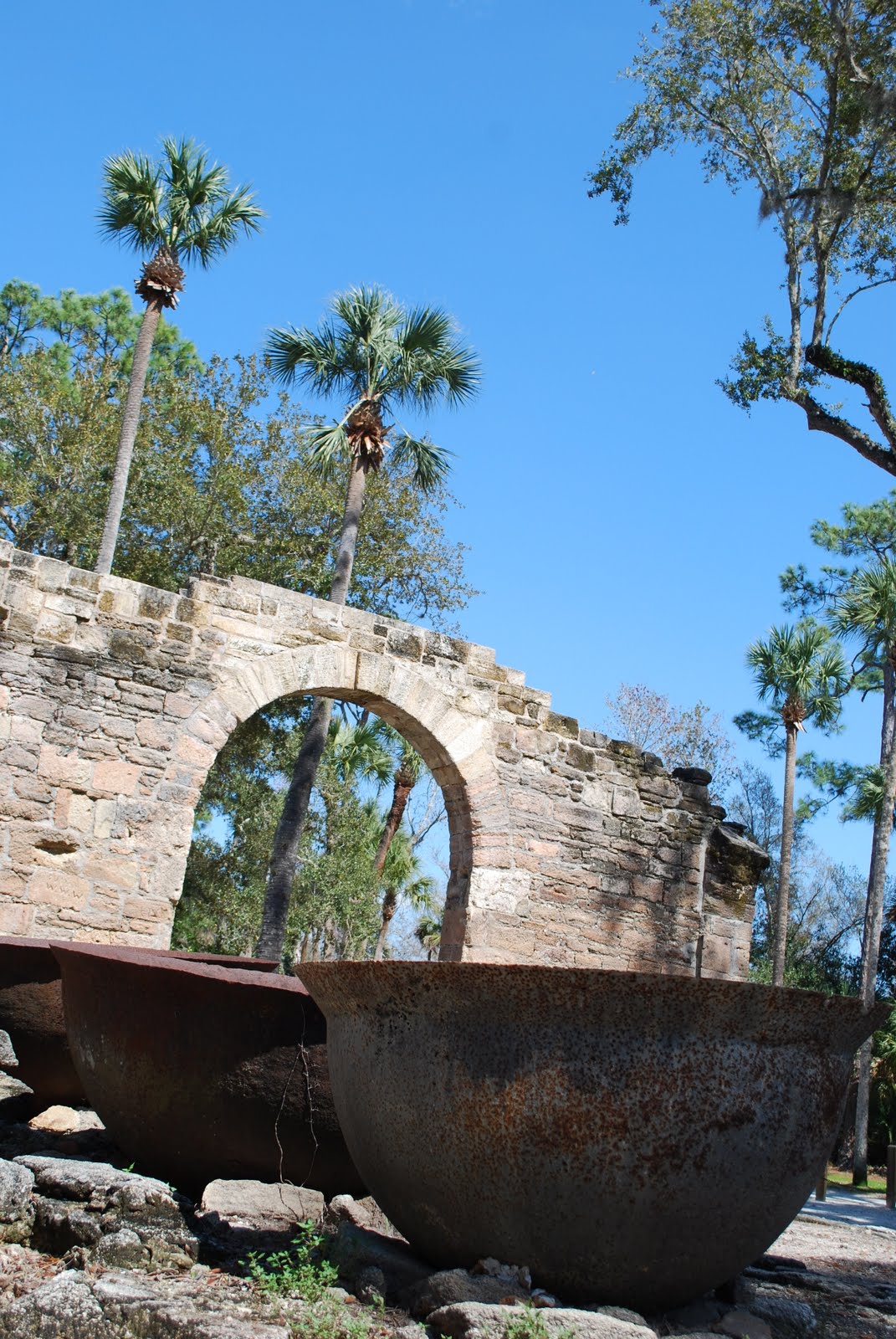
I've passed the sign many times without turning to see what the Sugar Mill Ruins were all about in New Smyrna. But on my 'archeological' excursion recently, I decided it was time to check them out. A small one lane dirt (mud) road leads to the ruins which are smaller than those in Ormond. Two things struck me about this site. First the interpretive signage was really good - lots of great information presented very clearly with well designed graphics. The signs were the result of an ECHO grant, which is Volusia County's way of supporting culture. I'm much impressed with the job they do up there, and I've seen evidence of these grants put to use for art exhibits, educational programs and historical displays. Good job Volusia County.


The second thing that struck me about the Sugar Mill is, like the large ruins of the Bulow Plantation, these facilities was destroyed by the Seminoles during the Seminole Indian war. There is so much awareness of the conflicts with western native peoples; everyone's heard of Custer's Last Stand, Geronimo, or the Trail of Tears. But there seems to be little awareness that Florida was the front line of the battle against native people by settlers pushing into this tropical wilderness. I think one could easily live here and be unaware that skirmishes were fought practically in their own backyards. I live about 2 miles from the location of a fort built during this period, and its presence is one of the main reasons Orlando even exists as a city. The only lasting reminders of this time are these stone relics of a thriving industry that was shut down because of war. Fascinating.


Some facts about the Sugar Mill in New Smryna:
• It was one of 16 sugar plantations built between New Smyrna and St. Augustine in the 1830s
• Built in 1830 by William Kimble, the plantation was destroyed just five years later during the 2nd Seminole Indian War of 1835
• The ruins were purchased by a wealthy New York stock broker for his wife in 1893 for the price of $400
• The remains of the mill were once thought to be part of an old Spanish Mission and were even rumored to be a chapel built by Columbus (see vintage postcards below)
• The site is now on the National Register of Historic Places and is a Florida State Historic Site

Postcards from the State Archives of Florida

Sunday, March 21, 2010

Audubon Center for Birds of Prey

We live within walking distance from a great old cemetery with a big old dead pine tree in the middle with an eagle's nest on top. We've watched from a distance as the breeding pair raised eaglets, bringing them food and later standing by as their young tested their wings before leaving the nest. The last two years, however, the nest has been knocked out of the tree by strong winds and this year two young eaglets came crashing down to earth with it.

Fortunately Central Florida has the Audubon Center for Birds of Prey in Maitland and the young birds were taken there for 2 weeks of rehab before they will be returned home. So on this first day of spring, Mrs. Ephemera and I decided to visit the center and were very pleased we did.

The Center was started in 1979 after Doris Mager spent six days and 5 nights in an abandoned eagle's nest to raise awareness of the difficulties faced by the bald eagle. Five months later the center opened and by the end of the year had admitted 66 rescued raptors. Today the Center treats almost 700 birds a year.

Toni the one-eyed Screech Owl

On our visit, we immediately met "Trouble" a male bald eagle with a twisted beak suffered as a result of early trauma or from a birth defect. He was handled by a slight young girl who we later watched in a video explain how they take care of the birds at the center. An older lady briefly presented a beautiful owl before running off to treat a Red Tailed Hawk that had just been rescued.


Entrance to the Center costs $5 and most of the experience is self-guided as you get to observe raptors who couldn't be returned to captivity due to the severity of their injuries. Here is list of some of the incredible creatures who live there:
• Bale Eagle
• Swallow Tail Kite
• American Kestral
• Peregrine Falcon
• Northern Caracara
• Osprey
• Red-shouldered, Red-tailed and Cooper's Hawks
• Screech, Great Horned, Barred and Barn Owls
• Black and Turkey Vultures
• American Kestral

Bird holding areas are called "Mews"

For me nothing beats observing these wild animals in their natural environments. But I gain a whole new level of appreciation seeing them up close. Actually, seeing them in captivity increases my desire to go bird watching in some our state's great natural areas. We are fortunate to have a place that is able to care for and rehabilitate these majestic creatures. But we are even more fortunate to live in a state that still has enough habitat left to see them where they belong, in the wild.

Northern Caracara

Red Shouldered or Cooper's Hawk

American Kestrals

Red Tailed Hawk

"Trouble"


Thursday, March 18, 2010

Britain's largest New World colony

The story of the Turnbull Colony in New Smyrna Beach is one of hardships caused by "weather, insects, Illness, and overwork." A plaque at Old Fort Park near downtown NSB tells the story this way: "During Florida's British Colonial Period, 1763-1783, Doctor Andrew Turnbull, established the largest North American colony at this site. Approximately 1800 Minorcans, Greeks and Italians comprised the colony named after Smyrna, Asia Minor, the birthplace of Dr. Turnbull's wife. The colony experienced success in producing indigo dye, rice, hemp, and other crops for shipment to England. Buildings, wharfs and a canal system, still visible today, were constructed. Despite successes, after nine years, the colony failed, approximately 600 survivors of the colony relocated to St. Augustine where many descendants reside."

What the plaque doesn't say is that the colony was set up for 500 settlers not 1,800, and from the moment they arrived in North America there were issues. The Volusia County website says the "mix of ethnic groups, with their different languages and customs, as well as problems with Indians, also made matters desperate" and "Turnbull's inability to produce marketable crops in quantities large enough to satisfy his investors cost him their support, as well as that of the British government."

Dr. Andrew Turnbull
State Archives of Florida


The casual beachgoer visiting New Smyrna for the day may pass within yards of the archeological evidence of the Turnbull Colony without even recognizing it. The most obvious example is Old Fort Park, the foundation of a coquina structure built by the colonists. Set on the site of an Indian shell mound, the “fort” was excavated and restored by WPA workers in 1933. While it is called a fort, the ruins are also said to be of Turnbull’s mansion, among other theories, and the exact nature of their original purpose are still uncertain today.


Two blocks South of the fort beneath New Smyrna’s charming downtown lies one of the several canals created by the colonists. Dug by hand and lined with coquina, a system of waterways was created for agricultural purposes beginning in 1768. While the Canal Street water passage is only visible west of US 1 for the most part, other canals are clearly visible at the boundary between the towns of New Smyrna and Edgewater and running through the park on Myrtle Avenue.


On the other side of SR 44 from Canal Street along Riverside Drive, the remains of Turnbull’s Old Stone Wharf are visible at low tide. Said to be the first public works program for the colony, the wharf was located at the end of the King’s Road that connected New Smyrna to St. Augustine.


To learn more about the Turnbull Colony, visit the The New Smyrna Museum of History at 120 Sams Avenue just off Canal Street. They have a fascinating exhibit with rare artifacts that help tell the story of what life was like in colonial Florida. New pieces of the puzzle are being uncovered continuously as archeological research into the colony is still ongoing. Researchers are delving through records in Scotland, Turnbull's home at this moment, through records that have been sealed for over two centuries. Stay tuned as the story is sure to change!