Saturday, May 1, 2010

Close to home, part 1


I've written before about Debra Jane Seltzer who travels around the country in her van named Sparkle with 4 dogs and an insanely long list of roadside objects to photograph. Reading her travel blogs have helped me appreciate roadside architecture more and really pay attention to the buildings I would normally drive right by without giving a second look. So last weekend I decided to take off on my bike and document some of the roadside architecture close to home.

I started with this coin laundry sign, not really an outstanding sign, but rare for Central Florida because it still works! We have very little original vintage neon still in operation. And this one is right down the street from me.


Next stop was the amazing Beefy King. Originally a chain of more than half a dozen eateries, the one on Bumby is the lone survivor. Here's what it says on their website: "Beefy King - The Greatest Roast Beef/Ham/Pastrami sandwich you'll ever have. Opened in 1967, and family owned, Beefy King is a true Orlando landmark. Home of "The Beefy"! This unique, sandwich shop uses meat that is cooked on-site, daily. Then, they steam the meat, the bun and wrap it in aluminum. Add some tasty spuds (tater tots), their unique barbecue sauce, milkshakes and family atmosphere, and you are destined to have a great eating experience." As a veteran Beefy King diner, I can attest to fact that all these claims are 100% true!

Just up the street, however was some mid-century architecture in peril. I've admired the details of the perpendicular rows of red blocks as I've driven past for years. On closer inspection from my bike, it appears as this vacant structure is being worked on, or perhaps even demoed.

Nearby is this mid-century office plaza with this cool Googie-like archway.

Around the corner is one of the few examples of programmatic or mimetic architecture in Orlando, (outside of the theme parks), this hot dog stand that seems to have found a home next to a vegetarian restaurant.


Just beyond that is Vega's Cafe, an Orlando institution for many years that is known for their Cuban sandwiches. A former Phillips 66 gas station, the large modernistic awning that once covered the gas pumps now provides cover for Alfresco dining.

Similar style gas station in Texas

Across the street are three giant statues in front of an Asian grocery store marking the area known as the ViMi district (Vietnamese/Mills Ave.) For excellent Vietnamese and Thai food, this is the place to go in Central Florida.


One of my favorite Chinese restaurants, Forbidden City is nearby in this mid-century structure that was once the Chic-n-Pit restaurant. Thanks to Shannon Jones for her helping uncovering the true identities of both the Pit and the Phillips 66.

Ad from Shannon Jones' 1967 phone book

Just beyond is one of my favorite Streamline Moderne structures, now known as the Track Shack. I'm not sure what the building was originally, but I'm working on it. It is widely known that the this style of architecture was influenced by the streamline ocean liners of the time, but few are this obvious!

This dry cleaner used to have wonderful neon signage. I believe one of the signs is in the collection of the Morse Museum in Winter Park and is still operational.


In a commercial area nearby I found these tasty architectural details.


I used to live next door to this 195os era bowling alley. At the time it was used as storage, with wooden lane still obvious beneath stacks of furniture. Sadly, it has not been a bowling alley for a very long time...

I lived in these 1940s era apartments with Deco details for several years. Sadly I never used the shuffleboard courts and now they have placed a picnic table smack dab in the middle of them!


While Orlando has few over-the-top, take your breath away, mid-century marvels, if one looks carefully enough, there are some little gems here and there. It's interesting what you see in your own neighborhood once you change the way you look at it!

Thursday, April 29, 2010

Last Day of Spring (a breakfast poem)


After the rush
the silence is broken
by my friend wren's
chirping
consistent and persistent
making my oatmeal
tastier
and the inevitable climb
up the stairs of self employment
more laborious

I revel in sixty
soon to be eighty
soon to be ninety

A clanky trailer
rattles the road
interrupting morning perfection
a song poorly ended

Reminder of inevitable
hot days in my attic


Tuesday, April 27, 2010

Polk Theatre and the Florida Dance Theatre

When I was offered free tickets to see the Florida Dance Theatre perform their Innovations show, I jumped at the opportunity, not only to see the performance but also to get to see the Polk Theatre. Built in 1928, the theatre designed by J.E. Casale is one of three of this style in the state, the Tampa Theatre and the Florida Theatre in Jacksonville being the other two. The theatre is described as a re-creation of a Mediterranean village "flanked by Italianate walls with niches, sconces, and faux balconies and windows" with a the "full scale Italian renaissance 'townhouse' setting that dominates the Polk’s interior."


Polk Theatre interior shots ©2009 Kilby Photo

According to the theatre's website, the Polk originally showcased both live vaudeville acts and films. "There was a stage trap door that was particularly useful for magic acts. Enticing locals with the “Hollywood Scandals” were the McCord Dancers, the Sun-Tan Revue, and The Green Pastures. The Chinese Houdini, Li Ho Chang, also performed live on stage, and of particular note was Sally Rand with her famous fan dance. Other notables to perform through the years include, Tommy Dorsey, Harry James, Gene Krupa, Eddy Arnold, Tom Mix, Gene Autrey, Glenn Miller and the king himself, Elvis Presley in 1956."

The theatre was restored in 1999 but as is the case with any old building, it needs constant maintenance and repairs.


I was much impressed by the building's decor, it reminded me very much of the Kimo Theatre in Albuquerque. However I was completely blown away by the performance of the Florida Dance Theatre. My brother does the photography for the Lakeland-based dance company, or otherwise I would have never heard of the group. I'm really not much of fan of dance I must admit, but if all dancing were like Innovations, that would be different. The show was more like Cirque du Soleil than Swan Lake, with the show broken down to short vignettes with multiple costume changes and a great deal of unpredictability. The movements were amazing, and to my untrained eye it appeared as if they were pushing the limits of the dance medium. I was entranced throughout the entire program. Sadly the attendance was pretty small, as Lakeland is not a huge market for this type of event. It was disappointing because the entire performance was amazing, creative and skillfully executed and the seeing the theatre alone was worth the drive over from Orlando.


Friday, April 23, 2010

Lakeland's Southgate arch

I recently re-watched the Tim Burton film Edward Scissorhands, which was filmed in Florida, and was thrilled to see the scene at Lakeland's Southgate Shopping Center. So I was excited to find out that it was just down the road from where I was staying on a recent trip to Lakeland. I had planned to do a Lakeland "photo safari" with my brother, but the weather did not cooperate. But I stopped at the 1957 shopping center to photograph their monumental signage, despite the rain.

Called a "flying saucer arcade" by the Lakeland Ledger, the shopping center's giant arch is mammoth in scale and has a huge support buttress behind it that lands in a neat little courtyard. In a thoroughly written article in the Fall 2001 SCA Journal, author Kim Hinder reports that the entire plaza cost over $1 million and an ad for its opening exclaimed "make plans now to rocket on down to help us celebrate the 'blast-off' of this 16 store galaxy."


The anchor store of the plaza was the Publix supermarket, and it was Publix founder George Jenkins who introduced many of the essential architectural elements we've come to associate with grocery stores today. Jenkins' innovations include "self-service meats and produce as well as groceries air conditioning, electric eye doors plate glass windows, 8-foot wide aisles," and perhaps most importantly, the idea to locate grocery stores in suburban shopping centers like the one in Lakeland.

Hinder reports that in 1956, supermarket design embraced the Exaggerated Modern style featuring "colossal canopies, parabolic arches, sign pylons, or pyramidal roofs" and the architect chosen to design in this style for Publix was Donovan Dean, the architect of the Southgate Shopping Center.

I first became aware of Dean through friends who live in a nearby Dean-designed house (future post.) According to an article in Reflections from Central Florida, Dean moved to Central Florida from Wisconsin in 1938, and eventually grew his architectural firm to have offices in Lakleand, Orlando, Cocoa and Winter Haven. Notable buildings he designed in the area include the Sentinel Star (Orlando Sentinel) building, St. James Catholic Church (currently undergoing restoration), and the corporate headquarters complex for Publix built in 1951. Below are some other buildings designed by Dean's firm, including some mid-century jewels, but none quite as grand as the Southgate Shopping Center.

The staff of one of Dean's offices, note the neon sign

Donovan Dean (love the pipe)

Greyhound bus station

I love how the signage accentuates the entrance

Publix Corporate headquarters

Typical Publix of the period, note the arch in the front


Archival images from Special Collections, Lakeland Public Library, Lakeland, FL

Monday, April 19, 2010

Biff Burger of St. Pete


My brother the photographer took this amazing image of the only operating Biff-Burger.

Biff-Burger of Haines City


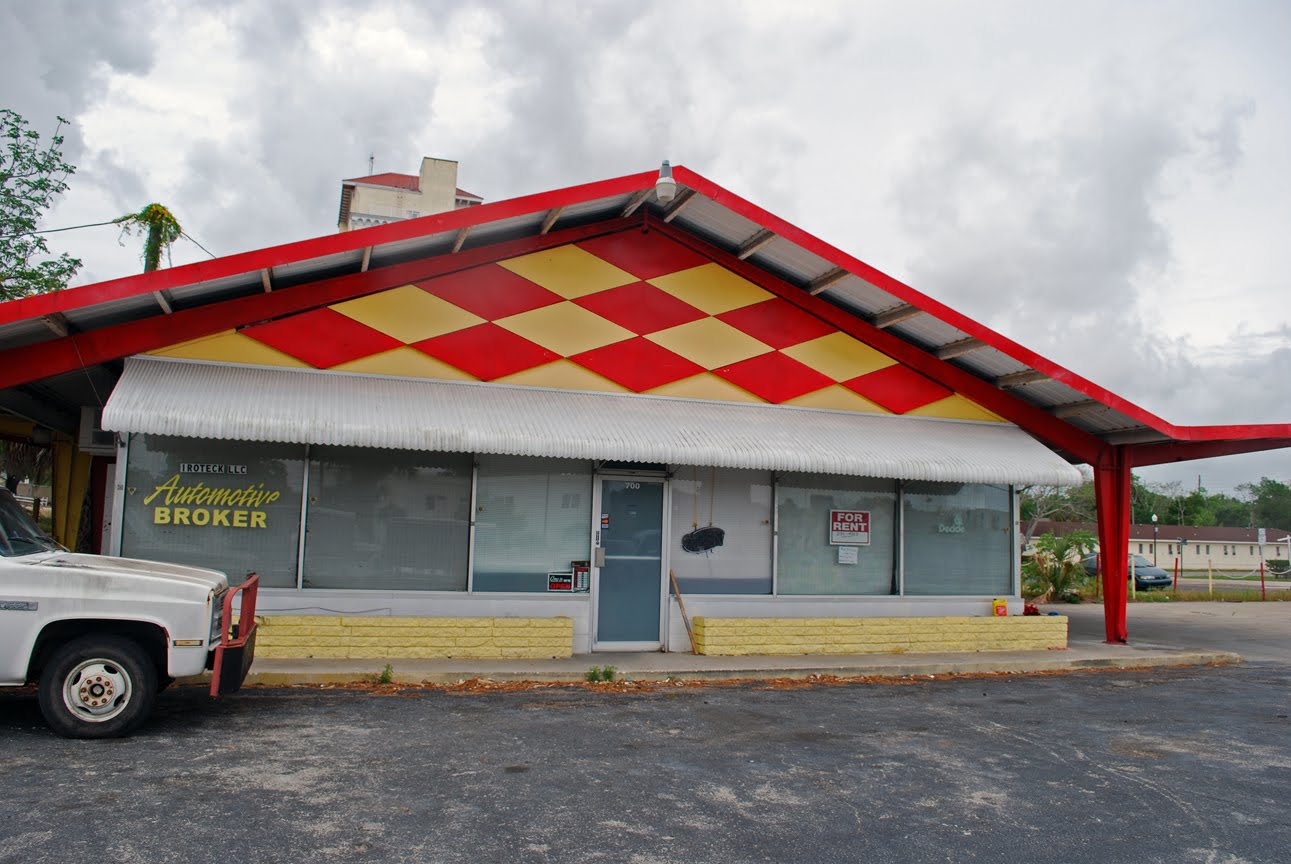
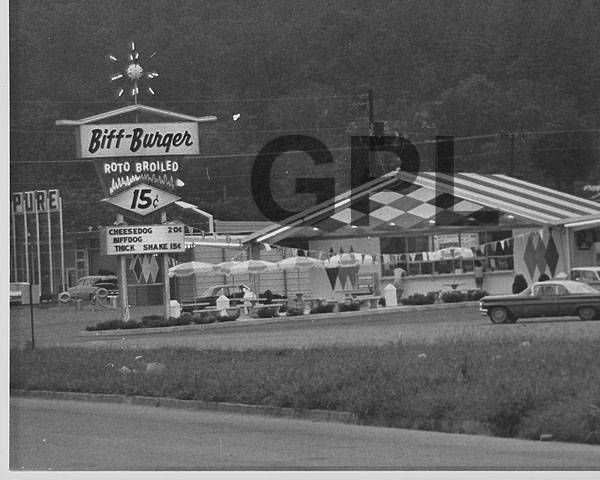
Mrs. Ephemera and I found ourselves toodling up US 27 in Polk County this weekend and I made a spontaneous decision to drive through downtown Haines City to take a look around. There are some interesting structures in the quiet little downtown that has obviously seen more prosperous times. As I drove into town, my eye was immediately drawn to this building, a bright red and yellow mid-century survivor with upswept wings on either side. It's latest use was home for a used car lot, but I suspected it originally was something else. So I dangled the photograph under roadside expert Debra Jane Seltzer's nose and in the blink of an eye she reported that it was a former Biff Burger and supplied a link to her website where I could see other examples of the now defunct fast food chain.


Originating in Clearwater in the 1950s the chain, (Biff stands for Best in Fast Food), grew mostly throughout the southeast until the mid 70s when it suddenly closed. Today the only eatery operating as Biff-Burger is in St. Pete. A link from Debra Jane's website to the Biff-Burger website supplies a great history of the now defunct chain including an evolution of its distinctive architecture.


Identifying the building a couple hours after photographing it makes me appreciative of the internet and wonder how we got along without it before? Perhaps we had to have more patience and sit down and write letters, make phone calls or actually go to the library to do research. I know experts say that the results of our technological age can lead to greater isolation, but to be able to have a mystery solved, almost instantaneously sure feels satisfying. Personally I feel more connected because of all the online relationships I've made over the internet with people who have similar interests. Folks who live all over the country and get excited about learning about a hamburger chain that closed 35 years ago. And now I'll be on the lookout for other Biff-Burger locations on my roadside wanderings, and perhaps they will too!

Vintage image from Gadsden Alabama Public Library

Sunday, April 18, 2010

For the birds


I'm always amazed at how Florida wildlife can prosper in the midst of some of our state's densest urban areas. The little lake I live on is just a hop, skip and a jump from downtown Orlando, yet at times it is an oasis of nature. One morning this week, I looked out the window to see a family of four Black Crowned Night Herons perched in a Live Oak above the water. I grabbed my camera and was shocked to find a plethora of wading birds; Great Blue Herons, Great Egrets, Snowy Egrets and even the occasional Wood Duck. It's the second time this spring where we've had this cluster of birds in one concentrated spot and my guess is that they are feeding on the fry of the Tilapia that spawn in great abundance this time of year.