Showing posts with label Joy Postle. Show all posts

Monday, May 25, 2026

Mural Mystery Solved (Mostly)

With the help of friends, I was recently able to solve a mystery that I first stumbled across in 2009 connected to a photograph from 1937. I first came across the image while I was diving into the archives of the Joy Postle Collection to source images for an article to be published in Reflections magazine. Thanks to Denise Hall, the collection at UCF is quite extensive and includes artwork, photographs and even the artist's diary she kept during the 1930s. The photo that intrigues me so much was of a group of dignified people, gathered in front of a large painting of a Seminole Indian. On the back in pen is written:

1937

W.P.A. Art Project

Trip to U. of F. Gainesville

Joy P. Don Emory

M. Runyon in Center

Special Collections & University Archives Libraries

University of Central Florida


I recently returned to the archives while researching Joy Postle's Casa Iberia mural on the Rollins College campus and was reminded that I had never figured out the location of the image, who painted the beautiful artwork, or who the rest of the people in the photo were. So I reached out to Flo Turcotte at the Archives at UF and she enlisted the help of fellow archivist Sarah Coates.  It was she who discovered the location of the image:

"Found it! It was over the fireplace in the Bryan Lounge that was in the Florida Union, now Dauer Hall. I have no idea if this painting is still there, nor do I know what the old Bryan Lounge was turned into once the building was no longer the Florida Union.

 She also sent links showing the space with the painting: 

To find out if the painting was still hanging on campus, I turned to Pam Marlin, an Instagram contact who works at UF and has done incredible then and now photo work on campus – you can explore her site here. Here was her response to my inquiries about the paintings whereabouts: 

"I don’t believe the painting is still hanging in the building. I’ve been to Dauer Hall many times over the years, mostly for events at the Keene Faculty Center (created when Dauer Hall was renovated in the 1990s).  The room with the fireplace and painting may have been part of today's faculty center, however, this particular area has been subdivided. It is now configured into multiple rooms that house the Classics Department (with the Religion Department upstairs). 
I walked over to Dauer today and captured a photo of the SE corner of the building where I think the original fireplace and painting were (see attached).  Visible in the photo is an exterior view of the large bay window (seen in the old interior photos) and exterior chimney stacks (suggesting a fireplace).    I also walked into the Classics Department area specifically looking for the bay window and the fireplace, but the space is now divided into many rooms, some wood-paneled, with no fireplace or a view of the large bay window. My guess is that the fireplace was either covered or removed during renovation, and possibly the painting along with it.  The beautiful interior arches have been removed as well."
Courtesy Pam Marlin

Pam later went inside Dauer Hall and reported:

"I walked over to Classics again and talked briefly with Robert Wagman, former Classics department chair (2009).  His office is located along the same wall as the fireplace (between the fireplace and the bay window) and it has the original dark wood paneling.  He told me that there is a wall over the fireplace, and likely the mural as well.  He took me to the room where it was located and tapped on the hollow wall.  He mentioned that when he was chair he encouraged them to open the wall, which they did not.  I have attached a photo (it is the back wall)." 

Courtesy Pam Marlin

As disappointed as I was that the painting is no longer viewable on campus, I was thrilled when both Pam and Sarah discovered the name of the artist who painted it: Fred Madden. Madden both attended and taught at UF. He painted the mural in 1936, the year before the photograph was taken. I found an article with photos of both the mural and a photo of the artist, and that allowed me to identify him in the group photo, standing front and center, just left of Joy Postle. 


From the Miami News, Oct. 1945

Madden, apparently an accomplished muralist like Postle, taught art at Camp Roosevelt, as did Postle, so it is likely they knew each other. Sorting out the other folks in the photo is a bit of challenge. Artist Manny Runyon, mentioned in the inscription on the back, appears to be the bearded fellow near the center of the image. O. C. R. Stageberg, UF professor of art and architecture could be the be to the right of Runyon, but it is difficult to be sure. It's also possible that Eve Alsman Fuller, an important figure at Camp Roosevelt, and an acquaintance of Postle, is one of the women on the left. Other possible people in attendance include Warren Doolittle, Van H. Ferguson, and William F. Lockwood. That aspect of the mystery still remains unsolved!

Halifax Historical Society

Don W. Emery


UPDATE: While attending a reception at the Halifax Historical Museum in Daytona Beach, I noticed several striking murals on the wall signed by "Don J." and "Don W. Emery." There was a display of the work by Don W., who was the son of Don J., but none of the photos matched anyone in my UCF image. But museum docent Carol Ann Moritz knew exactly where to look in the archives, and we found an image of Don W. He is standing behind Joy Postle, to the right. Another piece of the puzzle found!

Wednesday, March 13, 2013

Ode to Joy


I recently learned of a small gallery exhibition to honor the late Florida artist Joy Postle. I have posted about her multiple times in the past, ever since I received one of her works as a gift. The opening was last Saturday at the Deltona Art and History Center, and I was thrilled to be able to attend. The room had a wide variety of Joy's work, arranged in chronological order, with images of the artist interspersed throughout. Many of those in attendance were lucky enough to have known Joy before her passing in 1989, including Judy Madsen Johnson who did a reading from her book, Joy Cometh in the Morning.

I caught up with the artist who organized the show, Jennifer Myers Kirton, and this is what she had to say:
"For many years I have wanted to honor Joy but never before had the opportunity.  When I became curator of Deltona Art and History Center I was given opportunity to promote other artists which was my pleasure.  I had a series of things happen where I had a free month at the center and things just began to fall into place.  This show was thrown together in less than 5 weeks.  If I had had more time I might have been able to do more but I was so anxious to honor one of the art world's treasures."

How did you meet Joy Postle?
I first met Joy in the old Winter Park Mall. Joy had heard about me and called to see if I would do a working artists show. I was a little scared as I was a young housewife and mother who dabbled in art as a hobby but had no confidence.  Joy introduced herself and something special happened.  I got to escape into a world where I could practice my art in the midst of a busy place and still be creative.  Joy would check on me and encourage me. I was honored that such a great talent would take time with me but that was Joy. Interestingly enough I sat between Joy and Charles at that show.  Little did I know how much they would both influence me...

What was the most valuable thing you learned from her?
Wow! I learned that a woman could be an artist.  I learned that hard work and dedication could make up for not going to art school. I learned that nature tells her own story and that we do not replicate it on paper but look for the design of nature in nature. I think it was because of her I set out to draw everyday for a year or give up my art. This work ethic is still with me.  I think too many modern artists are not willing to put in the work and dedication that is required.

What made Joy unique as an artist?
Love – love of life, love of nature, and love of people.  This came through her work as she saw the birds wondrous creatures waiting to tell a story or glimpses of nature wanting to burst forth through art. She was gifted in that she could see in a lowly plant or critter something beautiful, something that needed to be shared. Again dedication and hard work tempered with talent and joy of life.

Where did all the artwork in the Deltona show come from?
Once we decided to do it several people offered personal pieces from their collections.  I had some, Loren King grew up near her and offered some, Madill's collection came from his late wife and his collection and Judy Madsen had some.  I could have used more but this was small venue. All of us knew Joy and had been touched in different ways by Joy. I think if I had a bigger venue and more time we really could have done her right but I truly hope that Joy would have enjoyed it and been touched.

What is your favorite Joy Postle painting?
Gosh that is hard to answer.  I think I like her birds and the one on stage was what she did in the height of her art. I like the panther because it goes beyond the canvas and you wonder how she could have drawn it with out quaking in her shoes.
The panther supposedly walked into the scene as Joy was painting it

What is it about Joy that makes people want to pay tribute to her and her work?
First of all she was a wonderfully talented person who lived a life that we can only imagine. She was a woman artist when women were not supposed to be artists.  She made it possible for women artists of today to actually practice what they love. I am younger but even when I was in high school my Dad was willing to educate me but I could be a secretary, nurse, teacher and definitely not an artist. Obviously she was talented but it is deeper than that it is that she captured a vanishing America despite her sacrifice.

Note: Joy Postle's beautiful mural of flamingos at Casa Iberia on the Rollins College campus is featured in my latest book, Shaping a Sense of Place: Historic Murals and the Aesthetic Character of Winter Park.  


What do you think Joy's legacy is?
She will go down I think as a true pioneer in American art.  She is a great artist who happened to be a woman. She captured landscape and wildlife in the natural setting that comes only with sacrifice. Today many artists take a picture with their camera and reproduce it – she made nature the picture and captured it on paper.
The rookery at Orlando's Lake Eola

Tuesday, November 23, 2010

An Extravaganza of Florida artists

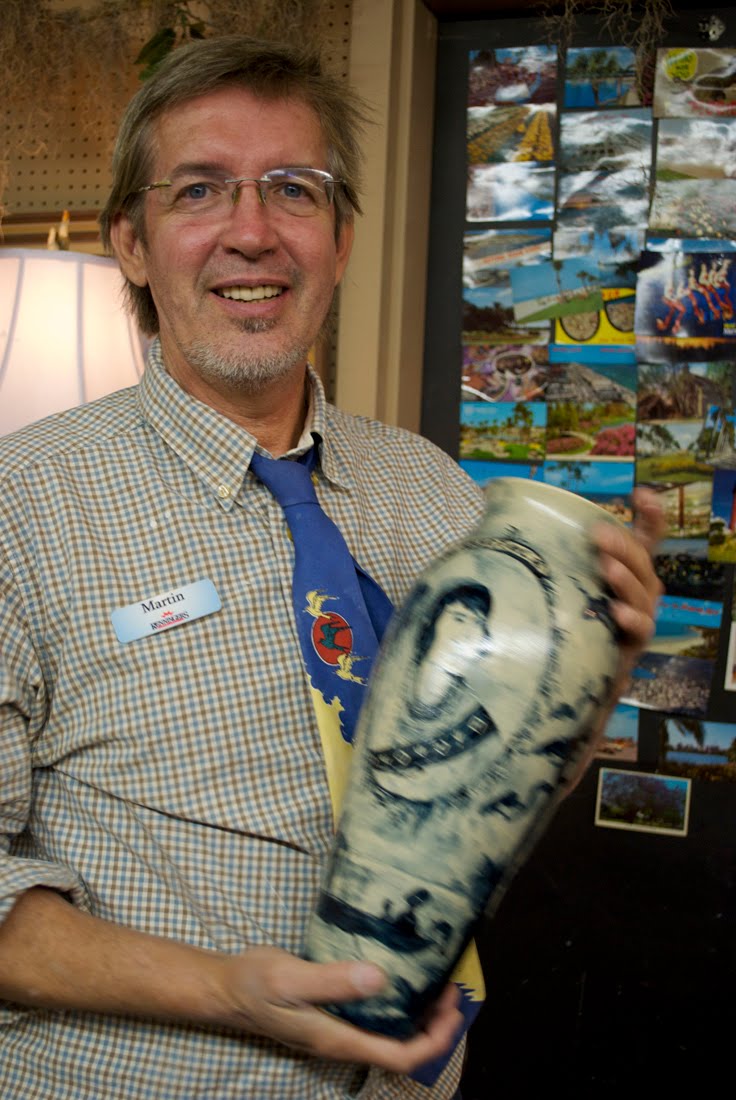
In addition to great antiques and collectibles, the Renninger's Extravaganza is chock full of great art. The extravaganza portion of the show consists of hundreds of outdoor booths. There is, however, a portion of the market that enclosed and is there year-round. That is where you will find the booth of Martin Cushman.

I have blogged about Martin before, as he is passionate about preserving in clay the aspects of old Florida that I love so much. His subject matter includes the native inhabitants of the sunshine state including its birds, animals and Seminole Indians. His pottery is beautiful and whimsical and it seems to me his work has grown since I last saw it, becoming more detailed and confident. And it is very cool that he even found away to vent his anger over the Gulf oil spill in his work. Martin has a unique voice and I am constantly inspired by the candor of his blog.


Directly across from Martin's booth, I was excited to see a large piece by Florida artist Joy Postle. One of her larger works, this incredibly detailed painting was priced pretty high, showing me that awareness of her work must be on the rise. I expect you'll be hearing more about this wildlife painter, performer and poet in the future.


Outside I found a piece of sculpture for sale by folk artist Jesse Aaron (1887-1979). I'm very familiar with Aaron's work as my best childhood friend's parents were early patrons of the Gainesville artist. Their house was full of his work, I thought it bizarre as a kid, but today I wish I owned some of his work. Coveted by collectors, it's pretty rare to good examples his work on the market. This piece was here last year, and it appears to be in rough shape.


According to Just Above the Water: Florida Folk Art by Kristin G. Congdon and Tina Bucuvalas, Aaron was of mixed African and Seminole Indian descent and he was born in poverty in Lake City, Florida. A manual laborer most of his life, he heard a calling to "carve wood" in 1968 and was prolific the rest of his life, starting his carving at 3 a.m. every day.

Florida State Archives

Drawings of Aaron and his work by Stuart Purser from his book Jesse J. Aaron Sculptor

The common thread among these three artists, is they saw something in their enviornment that we often take for granted. Martin Cushman sees beauty in the native critters and people of Florida (although the Seminoles weren't really indiginous to Florida, but that is a whole story unto itself.) Joy Postle, like Cushman was inspired by our state's natural wonders, especially its birds. And Jesse Aaron saw animals and faces in pieces of wood and created amazing pieces of sculpture out of them. Those of us who live in this state are surrounded by the inspiration for their art on a daily basis. Artists like these three, make us see our world differently and hopefully appreciate it more. They continue to inspire me.


P.S. Special thanks to Martin for the coveted excellence in blogging award!

Thursday, November 4, 2010

Orlando-Land


Yesterday was the day after the mid-term elections, a day which may have a huge effect on the future of of Florida and a day which I was thinking about change, constancy and the cyclical nature of things. It was also the day I got my hands on a May 1979 edition of Orlando-Land Magazine, a 31-year old time capsule into Central Florida's past. Published less than a decade after the opening of Disney World, its pages are great examples of how things change on one level but on another level remain unchanged.

Orlando-Land magazine was originally published in 1946 and was endorsed by the City of Orlando. The editorial in the May 1979 issue brags that the difference between Orlando and other tourist destinations is that visitors to Central Florida fall in love with the area to such an extent that they dream of living here. "It may emerge long before the first visit, instilled by the charisma of the Florida image... certainly it will turn to yearning during the long, cold winter nights back home... no wonder they come back-they're coming not only to play but to explore the possibilities of a new life here."

So accordingly the most prominent ads are those of new housing developments and office parks. The Central Florida they are selling is a lifestyle where one can jog, play tennis or fish on your lunch break. Where butterflies, egrets and palm trees sell homes that "start in the 30s." An ad for Wekiva reads "picture yourself nestled in a tranquil wooded setting where nature dictates your lifestyle...right in your own neighborhood you can enjoy hiking and biking on picturesque nature trails... playing tennis on the private courts.. canoeing and swimming at Wekiva State park... playing golf on the 18-hole championship golf course." The copy makes it sound more like a vacation spot than a housing development.

Most of the developments that were spawned in the explosion of growth right after Disney hit town are still there. Some are still semi-exclusive while others are now high-crime areas where I would not go at night. Some have been able to maintain the natural setting that was marketed so heavily, but most are locked in place by urban sprawl.

Click on images to see them larger

This week Floridians overwhelming defeated an amendment that would allow residents to have a say in checking the sprawl that is pushing the lifestyle advertised in this magazine, further and further into the state's undeveloped areas. While there may have been problems with that particular piece of legislation, it is clear that growth and development are still seen as critical to the economic health of the state by many Floridians. The question is how much development can our state endure until we have no more "tranquil wooded settings" to offer?

The reason I have the magazine in my possession is that it features an article about Florida wildlife artist and environmentalist Joy Postle. The description of the cover art by Postle reads "...Joy Postle's world is a world of birds in flight, birds fishing in the shallows, raccoons in the brush, graceful marsh grass, sunset colors on lake waters. It is an enduring word, here for the enjoyment of all who live here. Enduring in the face of rampant growth. Forever hers, and yours, and ours."

It is my deepest wish that this is true.


Thursday, December 31, 2009

2009 in Review


I made 186 Visual Ephemera posts in 2009 and I thought I'd review some of the highlights and update their status.

On January 3rd I listed some spots in Florida I wanted to visit, and I'm happy to say I hit most of them. I just returned from South Florida, although I wont' have any new blogs about the trip until 2010. While I didn't see Monkey Jungle, Parrot Jungle (Jungle Island now), or the Everglades, I did see the Coral Castle, Viscaya, the Biltmore and South Beach. And I listed a goal to visit the attractions in my backyard like Big Tree Park, The Citrus Tower and Hall of Presidents (yes on all 3.) While I didn't get to Tarpon Springs or Warm Mineral Springs, I did make trips to Weeki Wachee, Homosassa Springs, Sunken Gardens, Sarasota Jungle Gardens and Cypress Gardens.


Cypress Gardens, the granddaddy of all Florida attractions, is still closed and at this point its future is uncertain. My wish for 2010 is that it re-opens in some capacity, so Floridians and visitors can enjoy the beauty of its famed gardens again.


On January 12th, I blogged about the discovery of more Fountains of Youth in Florida, including the sculpture at Tomoka State Park which I just visited on Christmas Eve. I'll continue to explore the theme of Ponce de Leon and the Fountain of Youth in Florida's popular culture, and I have more discoveries on the the subject that I'll share in 2010. One of the highlights for me was visiting Punta Gorda, and finding several monuments to Ponce's adventures around Southwest Florida.


On February 19th, I introduced the late Florida artist Joy Postle. Since that initial post, a wikipedia page has been set up for Joy and an article came out in the Reflections journal of the Orange County Regional History Center. As a result there appears to be more awareness of Joy and her work, and we are hoping to put together an exhibition of work in the future. And the murals that were stored in an attic in Ormond Beach are now safely in the hands of the individual who is the caretaker of Joy's legacy.


In March I examined the plight of two Orlando institutions; one has stayed open, the other has remained closed. Kaley Elementary remained open when the local newspaper discovered the school board was not following the proper procedure in studying school closures, so they kept the schools slated for closures running this year. The Cheyenne Saloon, however, remains closed. My hope is that when the new arena opens next Fall, someone will re-open it because of its then desirable location.


In April I blogged about Casper's Ostrich and Alligator Farm, a long defunct St. Augustine attraction. I am happy to say that I recently received a Vintage Roadside shirt sporting the Caspers logo so I can do my part in keeping the memory of that unique Florida business alive.

May 21st's post on Sanlando Springs generated more comments than any other blog. Apparently there are many Central Floridians with fond memories of swimming there, who wish they could still visit it. The Springs development built around the popular spring was recently in the news when a resident was attacked by a Florida Black Bear. Later the man was charged with feeding the bears around his house after the bear that scratched him had to be put down.

July's post about the Sam Stoltz house in Mt. Plymouth produced many responses as well, and as luck would have it I met the man who would come to own the house. Florida artist Martin Cushman is now the loving steward of this unique architectural masterpiece and after many delays he has finally moved into his new home.


In August I utilized my contacts to help a friend find her ancestor's church. Since then she has made a commitment to speak at the church, and found her grandfather's gravesite at Greenwood Cemetery.


The city of Orlando is working to find ways to finance the repair of the Lake Eola fountain, the city's symbol for years, originally blogged about on September 3rd. However, the city of Winter Park continues to look for a way to expand its Central Park by moving the post office with no mention of the preservation of its unique mid-century murals.


November's post on the water skiing elephants of De Leon Springs led to an email interview with Liz Green Dane, who as a teenager appeared with her elephant Queenie at the spring. I have plans to meet with Liz in person next month to learn even more.


And this month I had the privilege of taking part in an interview with Ginger Stanley Rogers, who appeared in the iconic Creature from the Black Lagoon. She will be appearing at the History Center in March.


2009 has been a wonderful year for me, as my fascination with Florida's history and popular culture has grown as I've explored and learned more about the colorful state I'm in. I'm grateful for anyone who stumbles across my blog and my only hope is that if they are in Florida they take time to appreciate the uniqueness of this state, because it is changing rapidly, and the things that make Florida so wonderful are always at risk.