Saturday, October 27, 2012

Wolf Branch Sink


Last Saturday I woke up and got the paper and my whole day changed because of a story on the front page. The Lake County Water Authority was allowing visits to Wolf Branch Sink, a natural phenomenon not seen every day around these parts. There is a small waterfall on the site, one of two in Lake County, according to the video on the Orlando Sentinel website. If you are familiar with Florida topography, you know how flat the state generally is and a waterfall, however small, was worth the 45 minute drive to Mt. Dora.

While Mt. Dora is far from mountainous, it is pretty hilly and I have spent many weekends walking up and down the hills during the antique extravaganzas at Renninigers. The turn-off for the sink was just south of the railroad bridge over 441, down a nondescript road that took you by both a brand new housing development and ancient orange groves. Upon entering the property it is apparent why this sink exists as the elevation drops severely and all the water from a 5-mile square area funnels to this spot.

A Water Authority employee at the site told me that due to the recent drought, this branch had been dry for the last 3 years. But a very wet summer, including a September where it seemed like it rained every day, gave new life to the creek and the waterfall. I was told that the waterfall was first observed to have been flowing about two and a half weeks before. They hoped it would continue through today as they were opening up the site for visitors again.


The water flows from wetlands in the area and collects into the small branch which flows downhill over the small waterfall down a tiny "ravine" to a sinkhole where it slowly flows back into the aquifer. In a way a sink is the opposite of a spring.

The sinkhole was pretty modest, and we weren't allowed to explore its rim. The waterfall was flowing less when I saw it than it was in the Sentinel video, but it was still a pretty interesting. I followed the paths back into the Preserve and followed the creek all the way back to the railroad tracks. Huge stands of palmettos guarded ancient live oaks. Beautyberry bushes were everywhere and I wondered if I might see bears eating their brightly colored purple berries. I had a lovely, quiet walk on the well-marked trails and when I came back to the sink, the place was overflowing with visitors. The road leading into the preserve was packed with cars and I had to dodge pedestrians on my way out. I guess the novelty of a waterfall was so unique that it brought out large numbers of observers. But I found it very hopeful that so many people cared about this rarity in nature. On this day I found another encouraging sign that people in this state care a great deal about the environment, despite the reckless manner in which their elected officials treat it.


Thursday, October 25, 2012

Daytona's Atomic Tunnel


I admit it, I love roadside attractions, in particular those of Florida's golden age of tourism.  The sunshine state has been home to many unique attractions that did not survive the age of the interstate like Six Gun Territory, Tom Gaskin's Cypress Tree Museum, the Great Masterpiece, Floridaland and more. Check out the Florida's Lost Tourist Attractions website for a good list.  One of the wackiest on the list has to be Atomic Tunnel which was located on U.S. 1 just south of Daytona near Port Orange.


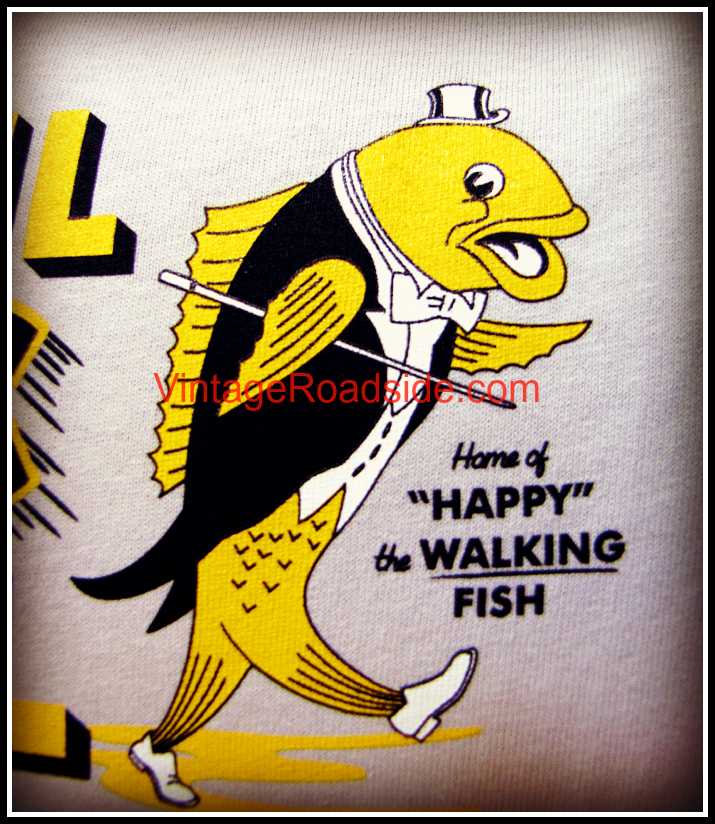
The Atomic Tunnel was the brainchild of W.R. Johnson who turned his 1950s bomb shelter to use as a tourist trap according to a history on the Vintage Roadside website. My friends at VR have done a great deal of work researching the short-lived Volusia County attraction, even finding its original location, which is a good trick from the opposite site of the continent (they are based in Portland.) Jeff and Kelly of Vintage Roadside are committed to keeping stories of unique places place like the Atomic Tunnel alive so they don't vanish from our collective memories.

An early rendition of "Happy" the attraction's mascot


Here's some more of what they were able to find out about the Tunnel:
-The Atomic Tunnel was renamed the "Tunnel of Fantasy" and then the "Tropicolor Fantasy"
- In addition to featuring the attraction's mascot, "Happy" the Walking Fish, other attractions included Smokey the monkey, Mac the macaw, a man-eating piranha and dancing mice

Promotion from when the name was changed to the "Tunnel of Fantasy"

I've rocked Vintage Roadside's awesome homage to the Tunnel in the form of a great red T-shirt for a number of years. So when the opportunity came to team with Vintage Roadside on one of their creations,  a limited edition Atomic Tunnel shirt, I jumped at the chance. They create a quality product and are a first class operation. Every person that wears one will be keeping a bit of old Florida alive. And at the rapid rate the quaint and charming disappear from this state, preserving every little bit helps.


Tuesday, October 16, 2012

My journey to the Fountain of Youth


I feel like I need to go to confession, even though I am not Catholic. Father, forgive me for I have not blogged in almost six weeks–I'd confess to my readers. But the reason is good–my Fountain of Youth project is going to be published and be included in a museum exhibit!

In past blogs I've revealed my obsession with Poncebilia, the Fountain of Youth, and Florida's springs. As I traveled to sites around the state, I began to see a narrative develop and my initial thought was to create an exhibit for the Orange County Regional History Center. So I started collecting ephemera and taking photos to support that exhibit. When it became apparent the exhibit space wasn't available at the History Center, I shifted my goals to a book. Originally I thought I would merely collect images, create an outline and hand it over to my friend Joy to write. But as the project came more into view, we decided that I really need to be the one to write it. So I soldiered on–collecting, photographing and writing whenever I had a free moment.

As I was working on the project, I got an email from an individual in Gainesville who was collecting images for a similar book about the Fountain of Youth. While I couldn't share my images, (because of my own project), I found that this individual was a kindred spirit and she introduced me to the work of Gainesville artist Margaret Tolbert and her Aquiferious facebook page. This opened up a whole new world and the book grew to not only include images and text about Florida's Fountains of Youth in the past, but also content about the current and future states of Florida's springs. That's how I learned about the proposed  project threatening Silver Springs. When the Save Silver Springs artwork I created caught the eye of nature photgrapher John Moran and his girlfriend Leslie Gamble, we collaborated on posters for a protest. I ran into John again at a Glen Springs clean-up in Gainesville and he wanted to learn more about my book project. After showing him the content for my book and my original exhibit proposal, he invited me to be part of an exhibit he was planning for 2013 at the Florida Museum of Natural History, then titled "Amnesia Springs." He also loved my book and sent an email to the publisher of his book "Journal of Light," University Press of Florida.

Photo by John Moran of me at Glen Springs
Poster I created with John Moran and Leslie Gamble at the Silver Springs protest

Weeks passed after that initial email introduction and I kept collecting materials for the book, and refining the text with the intent of self publishing. Then I received a call from the publisher expressing interest in my project. From that point on, events happened at a rapid pace. The text was finalized and sent to readers with a pdf of a preliminary layout. The manuscript was sent two experts on the subject, both of whom are authors of books on similar subjects, and they both gave glowing recommendations. The book was then submitted for approval by the editorial board. After the board gave thumbs up the project was rushed into production so it would be ready for spring of 2013 and the 500th anniversary of Ponce's landing in La Florida. The final manuscript was submitted, a contract was signed and I went to work on the layout, expanding it to 144 pages.

Before I finalized the layout I delivered a paper at the Society for Commercial Archeology's Conference in New Jersey titled: "Finding the Fountain of Youth: Florida's Magical Waters as Roadside Attraction." As I am a graphic designer by occupation, not a writer, the book is driven by the layout, and I was fortunate that the publisher allowed me design it. The final layout was submitted last week, and the book is now in the publisher's hands. I am currently waiting for edits, and in order to make our print date the book needs to go to the printer by December.


My goal with the book was to create something that would appeal to an audience that would not normally purchase a book about Florida history. Full of pop culture imagery, it is designed to be eye-catching and easily readable. It explores how the myth of the fountain of youth has become part of the branding of Florida and how our adoption of that paradigm has led Floridians to make choices that aren't necessarily the best for our state. In a way the book chronicles my own journey that started at the Fountain of Youth and grew into my desire to document Ponce de Leon imagery throughout the state, and culminated in recent trips to Florida's magical springs. At each step on this journey, I had no idea what the next step would be. I was committed to making the project happen, but I didn't know how. But I kept pressing onward.

So 2013 looks to be a big year for Ponce and me. The book should hit the shelves sometime around the 500th anniversary of Ponce's arrival and my part of the exhibit at the Florida Museum of Natural History should open in March. There is much work to be done, and there are many details that still need to be worked out. But I'll keep on taking one small step at a time, believing that somehow it is going to work out to be something fabulous and wonderful, and that it can make a real difference for our state in the end.

Saturday, September 1, 2012

Old Florida fix


This morning's bike ride was on the West Orange Trail on the southern edge of Lake Apopka. The trail follows the railroad that was established in the 19th century to ship produce grown in the region. I took the the trail from Oakland to Winter Garden with numerous side trips off the trail to take pictures. I was really needing an Old Florida fix, and this little excursion did the trick.

It had been a number of years since I biked the trail and its popularity has exploded in the interim. The parking lot was full and there were very few segments not being used by bikers, joggers or walkers. There are many new developments along the trail, including the Oakland Nature Preserve, a major force in preserving the region's history and natural environment. Unfortunately, Orlando's sprawl is encroaching and new suburbs have appeared near Oakland. There were two residential developments that showed the effects of the economy with paved roads and utilities but no houses.

This fish camp cabin, from Mt. Dora on the north side of the lake, is
one of the few remaining in the area
Beautyberries at the Oakland Nature Preserve
Tracks from the rail bed that the trail follows

Dock on Lake Apopka
 I saw the presence of the citrus industry in several spots; commercial packinghouses still remain even though very little citrus is grown in Orange County these days. It was fun to imagine trains taking this route through acres of groves and going for miles without seeing settlements. The small town of Oakland was put on the map when Judge James Speer agreed to give Russian Peter Demens 200 acres of land along the edge of Lake Apopka in exchange for routing the railroad through the tiny community. Oakland "boomed" from 1880 to 1890 until a devastating freeze crippled the citrus industry and a fire ravaged the community. Today the evidence of the towns history is intact in the form of some wonderful old homes and a few commercial buildings.


Details from the remnants of the citrus industry
Frame Vernacular house built in 1885 by Orange Belt Railway

Between Oakland and Winter Garden lies an area known as Tildenville with more fantastic 19th century homes, shady dirt roads, and enormous live oaks. Before reaching the quaint little downtown of Winter Garden, I went down to the lakefront of Lake Apopka. Newton Park originated as a tincan tourist camp, but was developed as a project of the New Deal in the 1930s. Several buildings and two arched bridges remain from that era. I shared the park with a plethora of wading birds, turtles, and some invisible alligators, that were heard but not seen. I found it interesting that on this holiday weekend the trail was jammed with people but the lakefront was deserted. Of course Lake Apopka, at one time the third largest lake in Florida, was horribly polluted by years of harmful agricultural practices. Once one of the premier bass fishing lakes in the state, the lake used to be ringed with fish camps. Today no fish camps remain and the lake is undergoing restoration with hopes of one day reestablishing an environmental balance. One of the more positive signs in the restoration has been the return of thousands of migrating birds every year. The latest threat, however, is a plans to enlarge a small airfield on the north side of the lake into a full scale airport. Environmentalists are concerned that this would have a detrimental effect on the birds, and they are trying to create a National Wildlife Reserve for the area.

Bungalow built in 1919 by citrus packinghouse manager Gus Hall
This Queen Anne Classical Revival house, built in 1900, is on the National Historic Register
WPA era feature in Warren Park on Lake Apopka
Great Blue Heron watches over Lake Apopka
Old building in Newton Park

My ride through West Orange County allowed me to fill my need to see some Old Florida and I also experienced all sorts of unexpected wildlife, from hawks to snakes. Every year the Audubon Society does a bird count around the lake, an event I'd love to participate in it someday. It will be interesting to see what happens to this large lake with a troubled past.

Labor Day weekend solitude on Lake Apopka
Postscript: For more information on West Orange County's history, I recommend "Sundays in the South: Touring West Orange County" by Rod Reeves and Kay Cappleman and "What Can I Say?" the excellent blog by Jim Crescitelli.

Saturday, August 25, 2012

The State of Preservation


Preservation of historic structures was on my mind this week, with preservation/demolition stories in the news in Pinellas County and in downtown Orlando, just a few miles from my house. The week started out with a critical meeting for the restoration of the Belleview Biltmore, Henry Plant's grand wooden hotel near Clearwater. The property temporarily survived a critical vote that may have allowed developers to demolish the property. The gilded age relic is not out of the woods yet, but it survived this round.


Belleview Biltmore from the State Archives of Florida

Not so fortunate was the Garden Cafeteria in St. Petersburg. Adorned with murals by WPA-era artist George Snow Hill, the building and the priceless artwork were knocked down this week. The Michigan-born Hill, who created murals for public buildings throughout Florida, passed away in 1969. A tough loss for my Pinellas County friends.


Photo from Saint Petersburg Preservation Facebook page
Photo by Ken Breslauer, Historic St. Petersburg

Closer to home five historic homes near the city's watery heart, Lake Eola, seem to have no relevance to local politicians, as they offered to give them away or demolish them. After paying millions for the property near the southeast corner of lake, the city announced that they had no desire to preserve the houses, despite the fact that one of the homes was owned by a Nobel Prize winner. 528 E. Washington was the home of John Mott, who shared the 1946 Nobel Peace Prize with peaceworker Emily Greene Balch. Mott, who won for his work with the YMCA, died in 1955. The other four houses were all built between 1920 and 1930.


The former home of Nobel Winner John Mott


On the one hand I'm thrilled the city stuck its neck out to buy the property during these tough economic times. If not for the downturn, there would probably already be a skyscraper on the site. But the parcel already sits next to large green space that is mostly unused except for a weekly farmer's market. It seems to me that at least one of the houses could be preserved and re-used, perhaps for weddings or meetings. It could actually generate income for the city. I have seen brides pose for pictures around the lake on numerous occasions; with landscaping and a privacy fence it could become a cherished spot for exchanging wedding vows. While I am not privy to the details of the deal between the city and the Trust for Public Lands, it seems to me that the city rushed the announcement to minimize any public outcry over the possible demolition of the houses. It seems all to similar to the city's decision to demolish a historical property known as the Jaymont Block in order for the developer to build soulless condominiums. The bright side to this story is that the there was a huge response to the offer of free homes, and some of them may be preserved yet.

I headed downtown to photograph the "Eola 5" on what is becoming my Saturday morning bike ride ritual. All five of the houses appear to be well-maintained as they are all being used as office space. The parcel has many large live oaks, and it is my hope that the city preserves them and maintains the wonderful canopy of trees.

Seeing the trees reminded me of another behemoth, an enormous Live Oak squeezed between a condo and an office building downtown. Seeing that it was doing well, I crossed under I-4 to see a great little commercial building in the Parramore district with restored beer signs painted on the front. It is my hope that this precious space finds a new tenant soon, as the advertising sign is a rare sight in Orlando.

Bike for scale

Restored by sign artist Jim Neal in the 1990s

Nearby is the Downtown Orlando Recreational complex, a cool deco building that might soon be demolished by the city as well. Next to the former Orlando Arena, the city is planning on building a "Creative Village" on the site, and this early 20th century building and the recreational facilities nearby do not fit in the city's plans. As I watched the continued demolition of the "Orena", I remembered how  proud the city was when the building opened just over two decades ago. I thought of seeing the first Orlando Magic game ever, Michael Jordan go for forty and Magic Johnson waving back to me during "garbage time." I recalled rim rattling dunks by Shaq, Nick Anderson missing critical free throws in the NBA finals and concerts like REM and the B-52s. As I rode my bike past the Bob Carr Auditorium, another facility doomed for the wrecking ball, (built on the shell of the old Orlando Municipal Auditorium),  I wondered what makes a building historic. Is it memories? Is it the people that lived there before? Is it architecture? To me all of those properties meet those criteria. While I know it is impractical to preserve every old building, it seems that a bit of a place's soul is diminished when it's past is disrespected. New residents don't invest emotionally when they move into a place without roots or a solid connection to the place's past. It's like building on a shaky foundation.

Downtown Recreational Complex
Site of the former Orlando Orena
Rubbish pile at the site of the future Creative Village
Former Orena parking lot 
Last week I stopped by the Strawn Citrus Packinghouse in DeLeon Springs, a property that was listed on the Florida Trust for Historic Preservation's Most Threatened list for several years. The site, one of the few facilities of its kind left in the state, continues to decay and it is sad to see a little more of it disappear every time I visit it.

There used to be a building to the right of this one
My wife and I live in a small bungalow built in the same era as the "Eola 5". The interior doesn't work well for 21st century living and our galley kitchen is not practical for entertaining (or even cooking with more than one person). We have worked with an architect and talked to several contractors who suggested that knocking down our house and building a new one would be easier than remodeling the one we have. But sometimes easier is not better, and newer is not preferable to a place with soul and history. This home has survived hurricanes, bugs, heat and humidity for decades before I was even born. It's more than plaster walls, heart of pine studs and hardwood floors. While the eaves may sag and the glass door knobs come off occasionally when you open a door, I feel like my wife and I have a relationship with this place and knocking it down would be like a taking out a family member. Spaces have souls. Cities have souls. It's up to us if we choose to honor them or disrespect them.

Postscript: On the way home from my bike ride, I passed Orlando artist/builder Sam Stoltz's Pine Green house. The new owners have done a wonderful job with it and it looks fantastic. Sam would be proud.

Pine Green near downtown Orlando