Showing posts with label Macaws. Show all posts

Monday, February 7, 2011

The 21st century Florida bird show


The tropical bird show has long been a staple of Florida tourism. Parrot Jungle, Sarasota Jungle Gardens, Sunken Gardens, Busch Gardens, and even Weeki Wachee all had bird shows. The image of the bicycling parrot is right up there with mermaids and flamingos as icons of Florida's tourist past. At places like Sarasota Jungle Gardens, the show goes on much as it has for decades, with colorful South American birds doing contrived human-like tricks for their handlers. A vintage brochure for Parrot Jungle asks:
"HAVE YOU SEEN BIRDS:
– RIDE BICYCLES
– ROLLER SKATE
– COUNT, ADD & SUBTRACT
YOU WILL AT THE WORLD FAMOUS 'PARROT BOWL"
SIX SHOWS DAILY
NO EXTRA CHARGES"


Parrot Jungle opened south of Miami in 1936 and is still in operation today as Jungle Island, relocated on an island between Miami and Miami Beach.

Sunken Gardens offered a bird show as well, but now that the City of St. Petersburg owns the venerable old attraction, the colorful Macaws and Parrots are relegated to cages.

Today the animal shows at both SeaWorld and Universal Studios focus on animal behavior and training and both feature bird performers. But the 21st century equivalent of the traditional Florida bird show has to be the Flights of Wonder Show at Disney's Animal Kingdom. Created by Disney's famed imagineers, the show is clever, funny and educational. "Instead of showcasing 'tricks,' they instead focus on only natural behaviors," according to "Beta Mike" who was formerly manager of attractions at the Asia section of Animal Kingdom. The message is heavy on conservation and the character of parrots is revealed to be "temperamental and (parrots) outlive their humans."


The show begins with an a trainer on an elaborate stage designed to look like a Silk Road Caravan Stage. She is joined on stage by "Guano Jane" a Disney comedian who jokes about wishing to see a parrot ride a bike. According to Beta Mike, the reference is a "tongue-in-cheek reference to the old Parrot Jungle shows," but the intention is to "shred every inkling people might have that they are about to see one of those old shows." The banter between the trainer and the Guano Jane is amusing, but the birds steal the show. We saw the following birds perform: Abyssinian Ground Hornbill, American Bald Eagle, Augur Buzzard, Gray-Crowned Crane, Harris Hawk, Macaw, Yellow-napped Amazon Parrot, Barred Owl and Spectacle Owl.


The birds for the most part played along, except for a Barred Owl which refused to cooperate. Birds swooped just inches away from the delighted audience's heads and one well-trained tropical bird actually snatched a dollar bill right out of a visitor's hand and then returned it. Guano Jane quipped "that's the first time any one's ever gotten their money back at a theme park."


The show closed with the entrance of a gorgeous Bald Eagle. Former Weeki Wachee mermaid Bonnie Georgiadis who later ran the bird show at Weeki Wachee, said during Lu Vicker's talk at the Floridiana Festival "...nothing compares the feeling of releasing a Bald Eagle into the wild," comparing her underwater swimming career to her bird show career. Seeing a bald eagle this close, it is easy to understand why.

As a lover of old attractions, I admit I enjoy the dated vintage shows like the one at Sarasota Jungle Gardens. But I also appreciate how the creative resources and attention-to-detail of Disney have updated a great old Sunshine State classic.


Black and white images from the State Archives of Florida

Thursday, May 6, 2010

Know your Florida Natives

A large portion of Gatorland is built around displays of animals from Florida and elsewhere. So today you get a quiz: are these Florida natives or critters from outside the Sunshine State?

Greater Flamingo. Florida Native?

Possibly. From eNature.com: "Resident in Bahamas, West Indies, Yucatan, northern South America, and Galapagos Islands. A casual visitor to U.S. coast from Carolinas to Texas. This species was formerly more numerous and probably bred at one time along the coast of Florida. Jeff Klinenberg reports in a 2002 St. Pete Times article: "Are they or are they not Florida residents? A prominent ornithologist described seeing an immense flock -- more than 2,000 birds -- near Cape Sable, in the western Everglades, in 1884. In 1901, an expert birder reported seeing a number of flamingos at Sugarloaf Key, near Key West, sitting on what appeared to be nests. Many experts today scoff. It's the only account of a flamingo nursery in the Florida wild. But nobody wants to say it's impossible."

Green Heron. Florida Native?

Yes. From the Cornell Lab of Ornithology website: "A small, stocky wading bird, the Green Heron is common in wet spots across much of North America."

Parrot. Florida Native?

No. This is the Yellow-naped Amazon Parrot. From Avianweb.com "Yellow-napes are endangered in their natural habitat which can be found along the Pacific Slope of Central America, in Southern Mexico and North-western Costa Rica."

Eastern Cottontail. Florida Native?

Yes. From wikipedia: "The Eastern Cottontail can be found in meadows and shrubby areas in the eastern and south-central United States, southern Canada, eastern Mexico, Central America and northernmost South America."

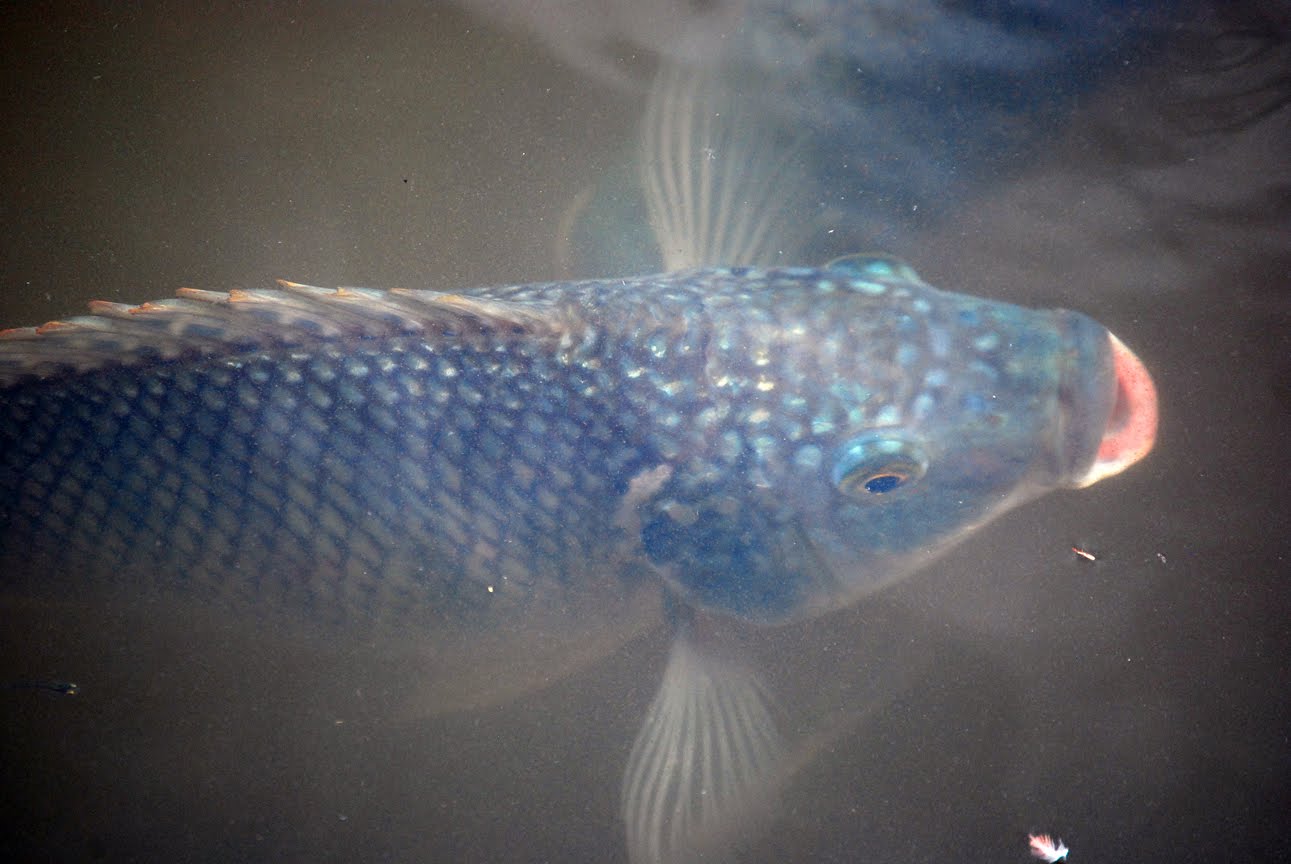
Blue Tilapia. Florida Native?

No. From the Environmential Defense Fund website: Most tilapia is imported from Latin America and Southeast Asia, where management and farming practices are less environmentally friendly than in the U.S. Since tilapia are not native to these areas, severe ecological damage can occur if tilapia escape to the wild.

Wood Stork. Florida Native?

Yes. From the Audubon website: "The striking, long-legged Wood Stork lives in colonies in cypress and mangrove swamps in the southeastern United States. It frequently flies in flocks, alternately flapping and gliding, or soaring on thermals to great altitudes. North America's only native stork, it is sometimes called "ironhead" or "flinthead" for its featherless, dark-skinned head."

Common Moorhen. Florida Native?

Yes. From the Cornell Lab of Orinthology: "The most widely distributed member of the rail family, the Common Moorhen inhabits marshes and ponds from Canada to Chile, from northern Europe to southern Africa, and across Asia to the Pacific. Vocal and boldly marked, the species can be quite conspicuous, sometimes using its long toes to walk atop floating vegetation."

Peacock. Florida Native?

No. From crystalinks.com: "Peacock or peafowl, large bird of the genus Pavo, in the pheasant family, native to E Asia. There are two main species, the common (Pavo cristatus), and the Javanese (P. musticus) peacocks, both found in deep forest where they travel in small flocks. A third type, the Congo peacock, was discovered recently in Africa."

Macaw. Florida Native?

No. From Avian Web: "Their native habitats are the forests, especially rain forests, of Mexico and Central and South America."

Gopher Tortoise. Florida Native?

Yes. From gophertortoise.org: "The gopher tortoises can be found throughout the state of Florida and southern areas of Georgia, South Carolina, Mississippi, Alabama and the tip of Eastern Louisiana."

Sandhill Crane. Florida Native?

Yes. From the International Crane Foundation website: "Sandhill Cranes are the most abundant of the world's cranes. They are widely (though intermittently) distributed throughout North America, extending into Cuba and far northeastern Siberia. The three migratory subspecies (Lesser, Greater and Canadian) are distributed across a broad breeding range in the northern U.S. and Canada as well as eastern Siberia, with wintering grounds in the southern United States and northern Mexico. The three non-migratory subspecies (Mississippi, Cuban, and Florida) have restricted ranges in the southern United States and Cuba."

Black Vulture. Florida Native?

Yes. From the Pergrine Fund website: "These vultures are found in lowland areas along rivers or in open habitats in the southern United States and throughout Central and South America."

Scoring:
12-10 correct answers: You're a genuine Florida Cracker
9-7
correct answers: You love your sunshine state critters
7-5
correct answers: You like pretty birdies but don't remember their names
4-2
correct answers: You rarely go outside because "they" might get you
2-0
correct answers: You've suffered major trauma to the head, and it's not your fault

Wednesday, April 15, 2009

Birds of a Feather

Caspers Ostrich and Alligator Farm wasn't the only attraction to use exotic birds to try to lure motorists off the road to spend a buck or two. Parrot Jungle, McKee Jungle Gardens, Carribean Gardens, Busch Gardens (above), and Bok Tower are just a few of the Florida attractions that featured exotic birds of some sort. Since the begining of the year, I've seen flamingoes, parrots and macaws at Homosassa Springs, Sunken Gardens, and most recently, at Sarasota Jungle Gardens.

While the birds and Homosassa Springs and Sunken Gardens are really just survivors of an earlier era, they are the major attraction at Sarasota Jungle Gardens. The Gardens themselves began in the 1930s when David Lindsey turned 10 acres of swampland in Sarasota into a beautiful exotic garden, according to Roadside Paradise. It opened as an attraction in 1940 and the "Birds of the Rainforest Show" was initially performed in 1972. Many of the birds in the show were rescued from the California Prison System, when a program that used exotic birds to rehabilitate prisoners was discontinued. Some of the avian performers used in the 1970s, still perform to this day, and according to the website, Frosty the 73 year old Cockatoo once performed on the Ed Sullivan show! It may be me, but it seemed like these colorful creatures projected a kind of wise, ancient energy. In the show, the exotic birds were asked to ride a bicycle, a roller skate and a scooter. The day we were there, the trainer was forced to be extremely resourceful to get the birds to cooperate. It was almost as if the birds were playing with the trainer.


The flamingoes live on an island in the middle of small lake but wade over to the feeding area where you can buy food out of a gumball machine and feed these tall birds. There were signs posted warning of aggresive behavior due to flamingo mating season, but that didn't stop most people from going right up to them, including children much shorter than the full height of the birds. I'm told to keep their amazing coral orange color they have to get exactly the right diet. And that diet is expensive, so attractions like Bok Tower no longer have Flamingoes. I noticed that the one at Sunken Gardens were a paler pink, as the City of St. Petersberg may not be able to afford the expensive flamingo food. But the ones at Sarasota Jungle Gardens are so bright it almost seems unnatural.