Tuesday, January 8, 2013

Viva Florida 500: Mythbusters Edition


April 2,  2013 marks the 500th anniversary of Juan Ponce de Leon’s naming of Florida.  The commemoration of Ponce’s landing has been designated by our state as Viva Florida 500 and Florida’s history will be highlighted throughout the year.  But because our state’s rich past is often misunderstood and ignored, I’ve prepared 7 Florida historical nuggets to prepare you for 2013. See how many you already know.


Fact or Fiction: Ponce de Leon discovered Florida.
Fiction: At the time of Ponce’s arrival in Florida, it is estimated that close to a third of a million Native Americans already lived here. The Timucuan, Calusa, Apalachee, Ocalii and other tribes lived in Florida thousands of years before the arrival of the Europeans. By the end of the 18th century, the last of these original Floridians, who had no immunity to the diseases brought by Europeans and enslaved Africans, were finally driven out of the state by the English and their Indian allies.

State Archives of Florida

Historians also believe that it is likely that other Europeans may have made unauthorized slaving expeditions into Florida before Ponce ever got here.


Fact or Fiction: Ponce de Leon was searching for the Fountain of Youth
Fiction: The origins of the Fountain of Youth legend can be traced back to the ancient Greeks and stories associated with Alexander the Great. While it is possible that Ponce had heard Indian legends of life-giving waters, the myth was not associated with Ponce until written accounts more than a decade after his passing. Historian Fernandez Oviedo, who seemed to have had a bone to pick with Ponce’s family, may have started the myth by writing that Ponce sought the fabled waters as a cure for impotence. In reality, Ponce was driven by the search for gold and glory.

Before landing in Florida, Ponce had become wealthy through agriculture and by supplying Indian labor for gold mining in Puerto Rico. When Columbus’s son Diego challenged his power, Ponce sought a charter from the King of Spain to explore the lands further north. In his two expeditions to Florida, Ponce encountered hostile natives, and was critically wounded on his second journey here and later died in Cuba.


Fact or Fiction: Ponce de Leon landed in St. Augustine
No one knows exactly where Ponce landed. St. Augustine has always made the claim to be where he came ashore based on a 17th century chronicle that says Ponce landed south of Ponte Vedra Beach. However a contemporary historian re-traced Ponce’s journey and landed near Melbourne Beach. Both sites now claim to be the site of Ponce’s first footsteps on land.  The truth is, we may never know, as there is no archaeological evidence of his landing.


Fact or Fiction: The English colony of Jamestown was the first settlement in the new world.
Fiction. St. Augustine was settled in 1565 by Pedro Menendez de Aviles. By the time the English landed at Plymouth Rock, the settlers in St. Augustine had children and grandchildren that were born in North America.  Historian Michael Gannon jokes that by the time Jamestown and Plymouth were settled “St. Augustine was up for urban renewal.”


Fact or Fiction: The Fountain of Youth attraction in St. Augustine is a fraud.
It depends on who your believe.
• Near the end of the 19th century, “Diamond Lil” McConnell uncovered a well on her St. Augustine property.
• Nearby was a rock cross with 15 vertical stones intersected by 13 stones horizontal stones. She believed it was a reference to the year of Ponce’s landing, 1513. She also claimed to have found a silver urn with a parchment inside that she thought confirmed the location as that of Ponce’s landing and the nearby well as the Fountain of Youth.
• In the early 1900s she opened her property as an attraction allowing visitors to drink the fabled water.
• After McConnell’s death the park passed to the Frazier family.
• In 1940s the Fraziers sued the Saturday Evening Post because the magazine asserted the property was not the Fountain of Youth. The Fraziers won the lawsuit and still own the park to this day.
• While historians agree the connection to the mythical Fountain of Youth is fabrication, the site has enormous archaeological value.


From the Florida State parks website
Fact or Fiction: St. Augustine was a destination of the Underground Railroad.
Fact: 100 years before the Emancipation Proclamation, escaped slaves fled the British Colonies and headed south to freedom in Florida.
• The Spanish granted the slaves freedom if they pledged allegiance to the King of Spain and converted to Catholicism. 
• The first free community of former slaves in the US was called Fort Mose (Moh-say). Just north of St. Augustine, the Fort was the first line of defense against the enemies of Spain.


Fact or Fiction: Members of the Seminoles Indians included escaped slaves
Fact: In the early 1700s the English began attacking the Spanish in Florida from their colonies in the Carolinas.
• They enlisted Indian tribes from outside the state to attack Spanish strongholds which included the remaining indigenous Indian settlements, many of who had converted to Catholicism while under Spanish rule.
• By the end of the century most of the native Indian population was wiped out and these tribes from further north, mostly Creek Indians, began to move into the state.
• These Indians, joined by escaped slaves, became autonomous and were called cimarrones by the Spanish, which means “runaway or wild ones”. This morphed into the term we use today, “Seminoles.”
• In the 19th century members of the tribe sought refuge in the Everglades, and today the descendants of these people live mostly in South Florida…

Coming full circle, just last Monday in South Florida, the Big Orange ball that drops to start the new year in Miami was renamed La Gran Naranja to honor Florida’s 500 year-old Spanish cultural heritage, and mark the beginning of 2013. Throughout the year, programs statewide will mark the anniversary of Ponce’s landing in La Florida.  

The above is an excerpt from a speech delivered last night to Toastmasters Chapter 1066, which meets on Monday nights at 6:45 at Legends Sports Bar on Orange Avenue in Orlando. In preparation for speaking events associated with my upcoming book release, I have been attending Toastmasters to improve my presentation skills. 


Sunday, November 18, 2012

Searching for Center in Seminole County


In college my graphic design professor insisted that we develop our own concepts. My classmates protested that "in the real word, copywriters will write copy and we'll just have to do the artwork!" But "Jack", the toughest and most influential instructor I had in my 4 years at UF, was unwavering and I went on to develop such memorable headlines as "It's A-maizing" for Argo Corn Syrup. My classmates still tease me about that one.

In my professional career working at small in-house design departments, I was forced to not only create my own concepts but even write my own copy. I also wrote radio ads, TV commercials even the script for a promotional video. Yet I'm still more at home in the visual realm than in the world of words. This realization was made more apparent to me after a Nature Journaling Workshop with the brilliant Florida writer Bill Belleville sponsored by the Center for Earth Jurisprudence.

I've just recently discovered the CEJ, whose mission is to advance a legal system that recognizes that ecosystems have inherent rights to be healthy. Yes, they are lawyers for the earth!

I attended a lecture by Jacksonville artist Jim Draper and fell in love with the organization and their methods of blending environmental education and spirituality. I eagerly signed up for the journaling exercise held at the Lake Harney Wilderness Area in Seminole County.

Just the drive to Lake Harney where the workshop was held was eventful. Soon after crossing over the St. Johns River, I made my way down Osceola Road and passed a huge sow sauntering down the side of the road, not a sight often seen in my urban existence! A short time later I passed a Gopher Tortoise striding down the yellow line between lines of traffic. Had I not been following another car, I would have stopped and moved him, but I am happy to report when I passed that way on my return trip, I saw no evidence that he ended up as roadkill.


The Lake Harney Wilderness Area is 300 acre parcel that Seminole County bought through a land acquisition plan similar to the state's Florida Forever program. According to the Seminole County website, the site is "home to the historic railroad crossing of the Florida east Coast Railway, Native American Shell middens, several bald eagles nests, oak hammocks and mixed hardwood swamps." We strolled down the Flagler trail to a scenic overlook built on top of a shell mound. Rusting evidence of the railroad bridge crossing was apparent next to this archaeological site. This area had been occupied by generations of Timucua, Miakka and perhaps Seminole Indians before the white man came along. Prior to Henry Flagler's railroad bridge, this location was a ferry crossing. It also served home to the logging town of Osceola. When the loggers had harvested all the trees on the site, they simply picked up the town and moved it down near the Everglades, leaving only the brick bank vault behind. As I wandered the site, it was thrilling to know I shared the same space as some Florida's earliest human inhabitants. Belleville did a masterful job of explaining the cultural history and the pointing out obscure natural details. It was not long before the location came alive in my mind as much more than the obvious physical appearances; it is a culmination of centuries of human occupation. I saw the natural setting with new eyes as I explored the nearby paths.


The lonely bank vault of the former town of Osceola
The St. Johns River

After soaking up the natural beauty as I wandered around the woods, I forced myself to sit and attempted to center myself. My first try at closing my eyes was interrupted by a buzzing mosquito. After two recent cases of mosquito borne Dengue Fever reported in the area, I was committed to staying bite-free and quickly soaked myself in bug repellent. I heard the sounds of insects, birds and pesky squirrels rustling palm fronds. I also heard speed boats and airplanes pass by. I couldn't sit still for long.

The observation platform atop the shell midden


I know the feeling of oneness with nature that Bill Belleville described so eloquently. I often experience that kind of serenity sitting on my dock of the little lake behind my house. It's like an immense wave of gratitude, and the certain realization that I am part of something larger than myself. I fit into nature's perfection. The anxiety of maintaining a manicured yard diminishes and I realize that by allowing native "weeds" to grow unencumbered, I've actually created habitat for a plethora of critters both seen and unseen. But on this day, at this beautiful setting, I could not shut down my urge to explore and to see new things. My virgin journal captured no brilliant words. I have to take time to process my experience in order to write about it. But my eyes beheld enough beauty for me to want to return to this spot again, and it left a mark on my heart. I felt fed and fulfilled. I'm fairly certain that alone was a more than an adequate outcome for this Sunday afternoon.

Rusty relics of another time show man's continual use of the site

Shell midden detail

A gorgeous fall day on the St. Johns River

Interpretive signage details the incredible human history found here
Native Americans must have eaten a great deal of these fresh water snails

Bill Belleville suggested getting a good guidebook of Florida wildflowers


Note the eagle's nest in the pine tree

Great use of modern technology

Bill Belleville at a historical marker

Saturday, November 3, 2012

May the Circle be Unbroken


Frank Lloyd Wright's round Guggenhiem Museum in New York opened on October 21, 1959, instantly becoming one of the best known works of modern architecture in the United States. Three years later, in 1962, another round work of modern architecture was built in Orlando with much less fanfare. Today the American Federal Savings and Loan Building is known to many Orlandoans as simply "the Round Building." Perhaps downtown's best surviving piece of mid-century modern architecture, the commercial structure is slated for demolition because it is located on the site of the city's new Dr. Phillips Performing Arts Complex.

The building was completed in two stages – the first two stories were completed with wonderful pre-cast concrete screen wrapping the exterior. Designed to accommodate an expansion upward, the building was later enlarged with five additional stories surrounded by nondescript glass windows. When I moved to Orlando it was known as the Coral Gables Federal Building, and it was an icon before the "renaissance" of Orlando's downtown.

The Central Florida Modern group led by Kevin Schweizer, the son of Frank Lloyd Wright protege Nils Schweizer, has been working to preserve the pre-cast screen, also known as a bris soleil, since 2008.  They sponsored a design competition to find ways of re-using the trapezoidal shapes in a new context. This week they held an event at the round building allowing entry to the unique structure one last time. In addition to offering tours, the award winning designs for the panels were announced and the head of the Cosanti Foundation spoke about Archology, Paolo Saleri's philosophy that combines architecture and ecology.

I spoke with the wife of the round building's architect who shared that the design was influenced by her husband's love of all things nautical. She also said he didn't care for the addition of the glass cylinder to his original design, and I have to agree that it never quite looked cohesive. Originally the executives had offices on the second floor overlooking a central lobby where tellers where placed in the center of the room. A large round skylight overhead let in natural light. Details of the original building still intact were wonderful wood paneling, round ashtrays and small round tiles in the bathroom. The circle motif was carried throughout the building.

The winning concept

Image from the Daily City blog

Image of the expansion from the Orange County Regional History Center
I was glad to have the opportunity to see this building up close one last time, and I was impressed with the turn out. While it is disappointing that it will be demolished, I was assured by city employees that at least some of the bris soleil panels will be preserved for re-use. It will be interesting to see how they are utilized. I left with a new appreciation for this Space Age edifice, and a new awareness of the how manmade environments of the future may look. From today's point of view they look just as futuristic as the round building must have looked in 1962.


A skylight originally adorned the ceiling

Looking towards the new Dr. Phillips Center

Saturday, October 27, 2012

Wolf Branch Sink


Last Saturday I woke up and got the paper and my whole day changed because of a story on the front page. The Lake County Water Authority was allowing visits to Wolf Branch Sink, a natural phenomenon not seen every day around these parts. There is a small waterfall on the site, one of two in Lake County, according to the video on the Orlando Sentinel website. If you are familiar with Florida topography, you know how flat the state generally is and a waterfall, however small, was worth the 45 minute drive to Mt. Dora.

While Mt. Dora is far from mountainous, it is pretty hilly and I have spent many weekends walking up and down the hills during the antique extravaganzas at Renninigers. The turn-off for the sink was just south of the railroad bridge over 441, down a nondescript road that took you by both a brand new housing development and ancient orange groves. Upon entering the property it is apparent why this sink exists as the elevation drops severely and all the water from a 5-mile square area funnels to this spot.

A Water Authority employee at the site told me that due to the recent drought, this branch had been dry for the last 3 years. But a very wet summer, including a September where it seemed like it rained every day, gave new life to the creek and the waterfall. I was told that the waterfall was first observed to have been flowing about two and a half weeks before. They hoped it would continue through today as they were opening up the site for visitors again.


The water flows from wetlands in the area and collects into the small branch which flows downhill over the small waterfall down a tiny "ravine" to a sinkhole where it slowly flows back into the aquifer. In a way a sink is the opposite of a spring.

The sinkhole was pretty modest, and we weren't allowed to explore its rim. The waterfall was flowing less when I saw it than it was in the Sentinel video, but it was still a pretty interesting. I followed the paths back into the Preserve and followed the creek all the way back to the railroad tracks. Huge stands of palmettos guarded ancient live oaks. Beautyberry bushes were everywhere and I wondered if I might see bears eating their brightly colored purple berries. I had a lovely, quiet walk on the well-marked trails and when I came back to the sink, the place was overflowing with visitors. The road leading into the preserve was packed with cars and I had to dodge pedestrians on my way out. I guess the novelty of a waterfall was so unique that it brought out large numbers of observers. But I found it very hopeful that so many people cared about this rarity in nature. On this day I found another encouraging sign that people in this state care a great deal about the environment, despite the reckless manner in which their elected officials treat it.


Thursday, October 25, 2012

Daytona's Atomic Tunnel


I admit it, I love roadside attractions, in particular those of Florida's golden age of tourism.  The sunshine state has been home to many unique attractions that did not survive the age of the interstate like Six Gun Territory, Tom Gaskin's Cypress Tree Museum, the Great Masterpiece, Floridaland and more. Check out the Florida's Lost Tourist Attractions website for a good list.  One of the wackiest on the list has to be Atomic Tunnel which was located on U.S. 1 just south of Daytona near Port Orange.


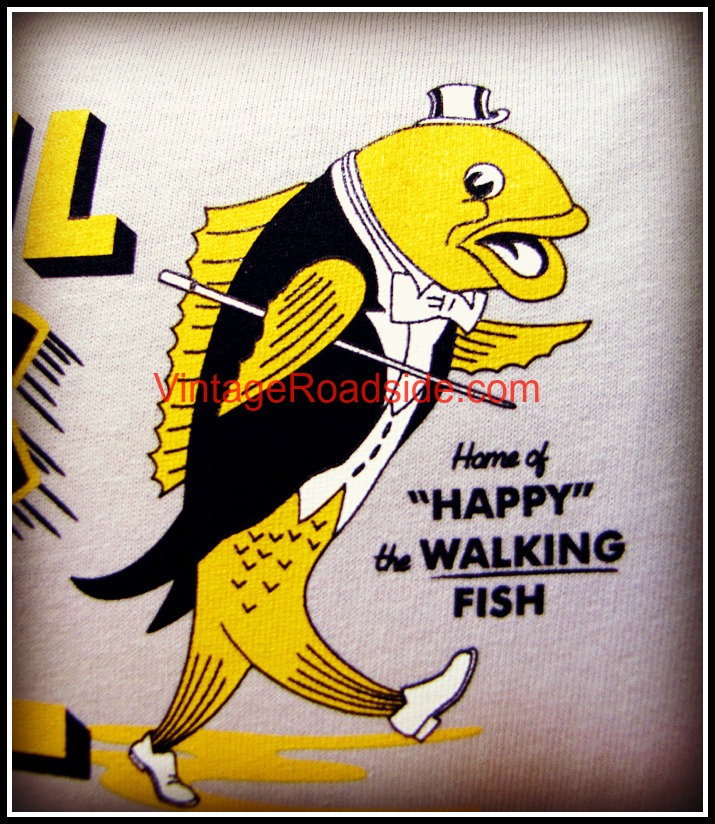
The Atomic Tunnel was the brainchild of W.R. Johnson who turned his 1950s bomb shelter to use as a tourist trap according to a history on the Vintage Roadside website. My friends at VR have done a great deal of work researching the short-lived Volusia County attraction, even finding its original location, which is a good trick from the opposite site of the continent (they are based in Portland.) Jeff and Kelly of Vintage Roadside are committed to keeping stories of unique places place like the Atomic Tunnel alive so they don't vanish from our collective memories.

An early rendition of "Happy" the attraction's mascot


Here's some more of what they were able to find out about the Tunnel:
-The Atomic Tunnel was renamed the "Tunnel of Fantasy" and then the "Tropicolor Fantasy"
- In addition to featuring the attraction's mascot, "Happy" the Walking Fish, other attractions included Smokey the monkey, Mac the macaw, a man-eating piranha and dancing mice

Promotion from when the name was changed to the "Tunnel of Fantasy"

I've rocked Vintage Roadside's awesome homage to the Tunnel in the form of a great red T-shirt for a number of years. So when the opportunity came to team with Vintage Roadside on one of their creations,  a limited edition Atomic Tunnel shirt, I jumped at the chance. They create a quality product and are a first class operation. Every person that wears one will be keeping a bit of old Florida alive. And at the rapid rate the quaint and charming disappear from this state, preserving every little bit helps.


Tuesday, October 16, 2012

My journey to the Fountain of Youth


I feel like I need to go to confession, even though I am not Catholic. Father, forgive me for I have not blogged in almost six weeks–I'd confess to my readers. But the reason is good–my Fountain of Youth project is going to be published and be included in a museum exhibit!

In past blogs I've revealed my obsession with Poncebilia, the Fountain of Youth, and Florida's springs. As I traveled to sites around the state, I began to see a narrative develop and my initial thought was to create an exhibit for the Orange County Regional History Center. So I started collecting ephemera and taking photos to support that exhibit. When it became apparent the exhibit space wasn't available at the History Center, I shifted my goals to a book. Originally I thought I would merely collect images, create an outline and hand it over to my friend Joy to write. But as the project came more into view, we decided that I really need to be the one to write it. So I soldiered on–collecting, photographing and writing whenever I had a free moment.

As I was working on the project, I got an email from an individual in Gainesville who was collecting images for a similar book about the Fountain of Youth. While I couldn't share my images, (because of my own project), I found that this individual was a kindred spirit and she introduced me to the work of Gainesville artist Margaret Tolbert and her Aquiferious facebook page. This opened up a whole new world and the book grew to not only include images and text about Florida's Fountains of Youth in the past, but also content about the current and future states of Florida's springs. That's how I learned about the proposed  project threatening Silver Springs. When the Save Silver Springs artwork I created caught the eye of nature photgrapher John Moran and his girlfriend Leslie Gamble, we collaborated on posters for a protest. I ran into John again at a Glen Springs clean-up in Gainesville and he wanted to learn more about my book project. After showing him the content for my book and my original exhibit proposal, he invited me to be part of an exhibit he was planning for 2013 at the Florida Museum of Natural History, then titled "Amnesia Springs." He also loved my book and sent an email to the publisher of his book "Journal of Light," University Press of Florida.

Photo by John Moran of me at Glen Springs
Poster I created with John Moran and Leslie Gamble at the Silver Springs protest

Weeks passed after that initial email introduction and I kept collecting materials for the book, and refining the text with the intent of self publishing. Then I received a call from the publisher expressing interest in my project. From that point on, events happened at a rapid pace. The text was finalized and sent to readers with a pdf of a preliminary layout. The manuscript was sent two experts on the subject, both of whom are authors of books on similar subjects, and they both gave glowing recommendations. The book was then submitted for approval by the editorial board. After the board gave thumbs up the project was rushed into production so it would be ready for spring of 2013 and the 500th anniversary of Ponce's landing in La Florida. The final manuscript was submitted, a contract was signed and I went to work on the layout, expanding it to 144 pages.

Before I finalized the layout I delivered a paper at the Society for Commercial Archeology's Conference in New Jersey titled: "Finding the Fountain of Youth: Florida's Magical Waters as Roadside Attraction." As I am a graphic designer by occupation, not a writer, the book is driven by the layout, and I was fortunate that the publisher allowed me design it. The final layout was submitted last week, and the book is now in the publisher's hands. I am currently waiting for edits, and in order to make our print date the book needs to go to the printer by December.


My goal with the book was to create something that would appeal to an audience that would not normally purchase a book about Florida history. Full of pop culture imagery, it is designed to be eye-catching and easily readable. It explores how the myth of the fountain of youth has become part of the branding of Florida and how our adoption of that paradigm has led Floridians to make choices that aren't necessarily the best for our state. In a way the book chronicles my own journey that started at the Fountain of Youth and grew into my desire to document Ponce de Leon imagery throughout the state, and culminated in recent trips to Florida's magical springs. At each step on this journey, I had no idea what the next step would be. I was committed to making the project happen, but I didn't know how. But I kept pressing onward.

So 2013 looks to be a big year for Ponce and me. The book should hit the shelves sometime around the 500th anniversary of Ponce's arrival and my part of the exhibit at the Florida Museum of Natural History should open in March. There is much work to be done, and there are many details that still need to be worked out. But I'll keep on taking one small step at a time, believing that somehow it is going to work out to be something fabulous and wonderful, and that it can make a real difference for our state in the end.